>

Friday, April 6, 2012

Take Your Lumps


— Oi — what’s for dinner?
— Lump
— Since when could we afford lump?
— We can’t. It’s day-old lump.
— Isn’t that a bit iffy?
— Not unless you cook it right away.
— It’s been ages since I had lump.
— Didn’t we have it for our anniversary one year? At that place?
— No — that was hump.
— Oh, right. It was a bit of alright though, that hump, wasn’t it?
— Delicious. Still, at the end of the day if I had to choose, I’d take lump.
— My mother used to make a nice bit of lump on a Sunday. Course, that was back when lump was plentiful. Everywhere you turned you saw lump on sale. Big lumps, too.
— Those were the days. I bet our grandkids won’t even know what lump tastes like.
— Terrible shame.
— What’s the world coming to. I ask you.

The Cooks and Confectioner’s Dictionary, John Nott, 1773

Thursday, April 5, 2012

Knock-Knock


Who’s there?
Orange.
Orange who?
Orange you glad to see me?

Have you ever wondered why children are so full of energy and out of control at birthday parties and wished you could rein them in a little? It’s all the sugar they eat in the cakes and ice creams and candies and such.

Next time you host a birthday party, serve this instead: Sunset Yogurt Salad. It not only looks pretty but is a sneaky way to get the kids to eat their fruit and veggies too!

Mix one packet of sugar-free Jell-O with a container of low-fat yogurt and let set. On top of this, stir 1 can of crushed pineapple and 1 cup of shredded carrots into another packet of sugar-free Jell-O. Garnish with lettuce.

There’s Always Room For Sugar Free Jell-O, Publications International, Ltd., 1992

Also from this book: Jell-O and Onions

Wednesday, April 4, 2012

Gastropub / Gastropig: Eating High on the Hog


Before the 1990s, if you wanted to eat in a public house, you had “pub grub.” After the 1990s, if you wanted to go to a pub to eat, you went to a “gastropub.” The kind of traditional foods one could previously find in a pub — the pub grub — were homely and nostalgic nods to what you’d get at home, ideally, if your wife was your mother and it was 1950: Ploughman’s Lunch, shepherd’s pie, bangers and mash, fish and chips, steak and kidney pie, Cornish pasties and the like. In other words, foods that filled your stomach and went well with beer. Fine dining establishments wouldn’t be caught dead serving this sort of common food, and they certainly wouldn’t refer to it as “grub,” a term reserved for casually prepared food one eats on the fly. What the gastropub did was to conjoin those two worlds, bringing the quality of fine dining to bear on the preparation of those much-beloved common foods, so that they could be consumed with ease in a shabby-chic environment — the pub. Naturally, the pub itself also underwent a sort of reverse gentrification, which emphasized the value of the antique environment over the tired utilitarian in all things from furniture to decoration to lighting. The stuff the pub is built of (worn brick, wood) is as visible as what the food is made of. In short, the gastropub morphed into the Apollonian Ideal of one’s local — the kind tourists see in coffee table books about English villages but which had become hard to find.

The rise of the gastropub went hand-in-hand with two culinary revolutions, each feeding the other. One was the locally-sourced and organic food movement, which, in focusing on smaller, independent crops, was able to re-introduce the kinds of fruits and vegetables that big agriculture could not produce — the kinds of delicate salad leaves and baby veggies one could grow in a garden, but not in a field. The gastropub could proudly display the origins of its ingredients on its chalkboard, giving the customer (or punter?) a sense of place if not merely the sense that they are eating responsibly. The other was the increasing acceptance of “snout to tail” restaurants whose menus revolved around the parts of an animal not usually considered something one would pay good money for.  It has become cool to have developed a taste for offal and bits and pieces — not simply because it suggests an adventurous palate, but because it appeals to those who want to say they are part of the cutting edge, whatever that may be. Only the “in” crowd would know what caché a reservation at St. John holds. At such places, rich men eat like poor ones; that is to say, they pay through the nose for noses.


 The butcher has regained the respect and visibility he once had when one bought meat from a butcher shop, because his expertise allows him to dismantle an animal in such a way as to make use of all its parts for human consumption. I use the masculine pronoun, though one sees far more women in the profession today. A woman engaging in butchery – wielding a big knife — is sexy in a somehow sexier way that a woman wielding a big knife to cut up an animal didn’t used to be.


But all this is not new — it never is. In 1773, it was the women who were charged with making ends meet — literally, making the ends of an animal meet their needs, because protein was scarce. Making these odds and ends palatable involves the addition of a lot of flavoring ingredients — herbs and spices — as can be seen in this recipe for Palates, Noses and Lips. The only difference between this recipe and a hot dog is that here the parts are served whole, whereas the hot dog has been cast of the proverbial “pink slime” rendered by intense puréeing.

You might not think you are eating such old-fashioned food when you chow down on a ballpark frank, but you are: it’s the same palates, noses and lips in a different shape, a different place. Though it might not seem like it, you are in fact eating high on the hog.

The Cook’s and Confectioner’s Dictionary, John Nott, 1773


Tuesday, April 3, 2012

Very Pinteresting!


This is the 1952 version of Pinterest: women sharing inspirational photos and ideas about food with each other through the newest medium: telephones. Today our communications are wireless, but this cover emphasizes the connection these women have literally through the phone lines tying them together.


This booklet suggests that women have nothing better to do than chatter, and that they have no external interests outside their kitchens — much like criticism leveled at Pinterest.

Meat Recipes You’ll Talk About, National Live Stock and Meat Board, 1952

Monday, April 2, 2012

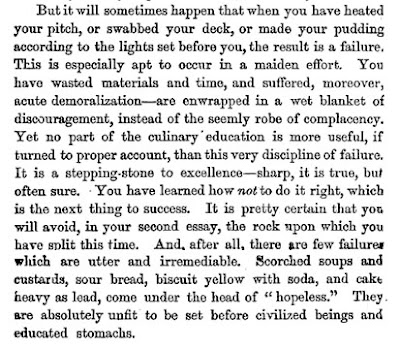
The Wet Blanket of Discouragement


Before cooks on TV told housewives that it was possible for them to be culinary heroes capable of making dishes chefs would be proud to serve each and every day, cookbook writers reassuringly put women in their place — and that was just below the level of rank amateur.

Instead of the cheerleader home cook who manages to look groomed and sexy while not making a mess in their spotless, fashionable kitchen, yesterday’s experts were more like hard-nosed coaches screaming at you to get your sorry ass up and try again.

In 1874, when Marion Harland wrote about common sense in the household, failure wasn’t as much of an option as it is now, when a ruined dinner can be fixed with a pizza delivery. Failure was something to be worked with and overcome. The main thing was to mask the disaster from your husband, so that he shall “remain in blissful ignorance that aught has gone wrong.”

This was a time when people used the word “aught” instead of “anything.” Aught is a far superior word of the kind used by women not afraid to tell novice housekeepers that their fumbling efforts cause them to be “enwrapped in a wet blanket of discouragement, instead of the seemly robe of complacency.”

The "robe of complacency" is not to be confused with the robe of terrycloth. 

The kind of women who use the word “enwrapped” are never failures.

Common Sense in the Household: A Manual of Practical Housewifery, Marion Harland, 1874

Also by Marion Harland: The Alternate Tale of Squirrel Nutkin, Stained, Roast Bambi

Saturday, March 31, 2012

Egg Wash


How long has shampoo been around? A long time, right? Well, hang on — there was that large period of human history in which people didn’t wash, wasn’t there? The Middle Ages? The Dark Ages? Back when they thought ridding the body of its greasy filth was bad for you, right? The era that comes to mind once in a blue moon when you’re clipping your nails and wonder how folks gave themselves pedicures before the invention of nail clippers. Or scissors. Did they chew their toenails off? People were hairy in those days — after all, no safety razors. Before sharp knives, did they depilate with lava rock? Probably. And the teeth — it doesn’t bear thinking about. Compared to the whole teeth (and oh God, menstrual blood) situation, shampooing seems like rather an effete luxury.

Truth is, people didn’t bother with shampoo much before the 1970s — yes, the nineteen-seventies. Farrah Fawcett’s hair went a long blonde way towards convincing women that they needed to shampoo their hair regularly. Shampoo (from the Hindi word, champo) had been around since the turn of the century, mostly in the form of a soap and surfactant, and the Mughals used shampoo consisting of an alkali and essential oils for donkey’s years before that. Originally it meant to massage these oils into the scalp, rather than washing the hair, per se.


So what did ordinary people do before the seventies? They used eggs. The protein in eggs actually makes a wonderful shampoo, leaving the hair all glossy and strong. Egg shampoos are coming back in the expensive salons as an all-natural treatment, but you can always do it yourself at home for dead cheap.

Kentucky Receipt Book, Mary Harris Frazer, 1903

Friday, March 30, 2012

Booze Cake


— Ed, you know who that was at the nametag table?
— No, who?
— Mrs. Pollard.
— Who?
— Sue Pollard’s mum.
— Good Lord.
— She was a cracker, wasn’t she, Ed?
— She was that.
— I loved that woman. I wanted to marry her. I wanted her to be my mom too.
— That’s not how it works, Steve.
— You know what I mean, don’t tell me you don’t. How old were we?
— 12.
— Right. How old was she?
— Somewhere between 30 and 35 I should reckon.
— But she looked so much younger, didn’t she?
— She looked inebriated, most of the time.
— You’d go round to Sue Pollard’s house to play and she’d offer you a drink. And you’d say thanks, and instead of milk or juice she’d hand you a snifter.
— She didn’t want to drink alone.
— She was handy in the kitchen though — you couldn’t fault her. It wasn’t like she was falling down drunk. She always had something baking.
— She was a functional drunk.
— Like us?
— Like us.
— Remember that birthday party where she served that cake and all the kids fell asleep?
— The booze cake! Oh, man.
— Whatever happened to Sue Pollard?
— She got married, like the rest of us. That Wiecher guy.
— Which Wiecher guy?
— Him, over there. The one with the ridiculous suit.
— If he’s here, how come Sue isn’t?
— Divorced, probably. Like the rest of us.
— I hate these things. Why do we come?
— Don’t know. Maybe meet someone.
— Never gonna happen, my friend.
— I really want that recipe for that booze cake.
— Seriously?
— Absolutely.
— Go for it. Ask her.

The Golfer’s Cookbook, Rose Elder, 1977

Thursday, March 29, 2012

Bloater Paste


The term “red herring” gets its name from the supposed use of kippers (pungent split and smoked herring) being used to train hunting dogs to follow a scent by misleading them.

While kippers are associated more with Scotland and the Isle of Man as a powerful emblem of a much-beloved but difficult food, England is home to the bloater (a cured whole herring), specifically in the form of bloater paste.

Kippers
Eating a kipper requires a great deal of careful expertise in negotiating the lethal froth of needle-like bones, whereas bloater paste is simply smeared inside a sandwich. One would think the paste would have been most likely to survive the culinary softening of the twentieth-century palate, but it didn’t: it fell out of favor with the sandwich-eating public (despite the ubiquitous rise in popularity of the sandwich) and has been discontinued, whereas you can still pick up a pair of kippers for your breakfast at any fishmonger and play a kind of swallowing Russian Roulette.

Bloater paste’s demise was probably due in large part to its name; after all, no-one wants to be reminded what eating too many sandwiches (especially made on today’s yeast-puffed bread) will do to one’s stomach. Along with such antique staples as Mock Turtle Soup and Blancmange, it had its heyday in the Victorian and Edwardian eras, when the usefulness of food that came in cans and bottles preceded that of frozen foods.

People needed pre-packaged foods that would not spoil in part because they travelled more than they ever had. Railways and ships allowed folks to visit distant places and they needed to eat along the way. Specifically, preserved foods were a boon to explorers whose exploits could not have been possible without them. Antarctica, for instance, cannot support life, so everything needed to keep a human going had to be brought in.

From Bowers' list of ship's stores, Terra Nova 1910

For an expedition such as Scott’s attempt on the South Pole, this meant packing for at least three years. The store lists set down by his right-hand man Birdie Bowers reveal massive quantities of foodstuffs that could be found in any Edwardian pantry — including 20 dozen quarts of Bloater Paste. (also: Mock Turtle Soup = 200 ½ lb tins and Blanc Mange Powder = six dozen pints.) For kipper they substituted penguin.


100 years ago today Scott and his party died of cold, but mostly of starvation — because a starving person cannot keep warm. Towards the end his party all dreamed obsessively of food — a subconscious trait the body uses to prod one into seeking it. The kinds of food they gorged themselves on while asleep were comfort foods, as one can imagine. Perhaps they dreamed of bloater paste sandwiches. Perhaps they dreamed of kippers, warm, running with melted butter and lemon juice. Perhaps they chewed their nails or their shoelaces. Perhaps all they saw were red herrings like flags hanging from bamboo poles above insufficient depots on the frozen sea. 

Wednesday, March 28, 2012

Asparagus-Potato Mold


Some interesting facts about asparagus:

It used to be in the lily family, but now it’s in its own family. The berries of an asparagus plant are toxic to humans. Nevertheless, humans have been eating asparagus for at least 20,000 years. In the very first cookbook, De Re Coquinaria, Apicus advises drying the stalks before immersing in boiling water backwards. In England, it used to be known as “sparrow-grass.” Asparagus is extremely high in folic acid, which has been shown to retard Alzheimer’s Disease. It is also a diuretic, which makes you pee, and contains a lot of fiber, which makes you move your bowels. Washing your face with water in which asparagus has been boiled helps remove blemishes. Asparagus repels tomato nematodes, and tomato plants repel asparagus beetles. The German town of Schwetzingen crowns an “Asparagus Queen” during its annual festival. While most people produce odorous urine after eating asparagus, only 22% of people are genetically predisposed to be able to detect it. No-one on Earth likes Asparagus-Potato Mold, so don’t ever serve it.


Woman’s Day Encyclopedia of Cookery, Fawcett Publications, Inc., 1966

Tuesday, March 27, 2012

Martha's Sweet and Sour Tongue

This summary is not available. Please click here to view the post.
Pin It