>
Showing posts with label Pineapple. Show all posts

Wednesday, July 2, 2014

Kitchen Nightmares


A local restaurant was advertising their summer special on the radio the other day. The special was a shrimp, avocado and strawberry salad. Good luck with that.

Gordon Ramsey’s restaurant makeover show, Kitchen Nightmares used to be a good show when it was filmed in Britain. Well-meaning people did badly because they just didn’t have a clue. Then he did a version in America, but it featured a smarmy narrator with pop-in quickie comments by Ramsey, and mostly him throwing fits, which is what Americans like to see. They don’t care about sincerity; they just want reality show drama. So they picked insane eateries run by insane people. Thus it is that Ramsey’s reputation in America is one of being a bully and a coarse-mouthed thug in a white jacket. It has nothing to do with cooking.

What had happened was that the American show was a TV version of the very thing he was trying to “fix”: it was a rubbish show, with a terrible “menu” of content and no amount of shouting could rescue it from oblivion.

Whenever I see food pairings of obvious folly, I am reminded of Ramsey’s original show. In it, he often had to explain to hapless chefs why strawberries don’t go with fish or some such incompatibility of nature.

There is no need to put pineapple on top of your barbecued ribs. Don’t do it, people.

Meat Cook Book, Better Homes and Gardens, 1969

 Also from this book: Common Cored


Tuesday, July 16, 2013

Sauerkraut Stuffed Pineapple


Do not try to bring hummingbirds into Hawaii. They will not let you. It is strictly prohibited. It is verboten. Not even if it is your favorite pet hummingbird. No way, no how. A soon as you land in Hawaii, they throw a lei over your shoulders and search you for contraband hummingbirds. Aloha my ass for the hummingbirds. Do not hide a hummingbird in your pants. Don’t even joke about the hummingbirds. Sure, you may find that once you have booked your passage to Hawaii, you will be inundated with requests from hummingbirds to secure themselves as stowaways in your baggage, because they, too want to go on holiday to Hawaii. But do not accept their bribes. If a hummingbird decides to hide in your baggage, and is discovered, he or she will meet a grisly end. Hummingbirds are not welcome in Hawaii.


This is because hummingbirds are attracted to bromeliads and end up pollinating them. But this is great! you say. How convenient! Isn’t nature wonderful! Surely the world could use more bromeliads! Hang on, what’s a bromeliad?

Pineapples, for a start. They are the most delicious bromeliads around. Companies like Dole and Del Monte have invested a lot of time and money into making sure your pineapple is succulent, sweet, low in acid, and lasts until it reaches your local supermarket. What ruins pineapples is seeds. And what makes seeds? Pollination. And what pollinates pineapples? Hummingbirds. Hence the ban. 

Pineapples aren’t even native to Hawaii; they were brought over from South America and soon found a home in the perfect climate. Hawaii might very well be associated with the pineapple, but it doesn’t even crack the top 12 list of nations producing the most pineapples.

It sucks to be a hummingbird.


Here is a picture of a pineapple stuffed with hot sauerkraut from Germany. Enjoy. 

The Cooking of Germany, Time-Life Books, 1968

Tuesday, January 8, 2013

Wash Your Mouth Out With Soap


Handmade small-batch soaps look pretty and smell delicious, especially when sold at farmer’s markets in blocks, which are sliced to order, wrapped in tissue and sealed with a little sticker. You often find that the soap has been studded with chunks of other soap for color or aroma. Perhaps an opaque base of shea butter soap is married with some clear gelatin-based concoction.

Here is a soap meant to impart a minty freshness to your daily bathing routine. Serve it with lettuce and . . . wait . . . this isn’t soap!

Salad Book, Better Homes and Gardens, 1969

Thursday, April 5, 2012

Knock-Knock


Who’s there?
Orange.
Orange who?
Orange you glad to see me?

Have you ever wondered why children are so full of energy and out of control at birthday parties and wished you could rein them in a little? It’s all the sugar they eat in the cakes and ice creams and candies and such.

Next time you host a birthday party, serve this instead: Sunset Yogurt Salad. It not only looks pretty but is a sneaky way to get the kids to eat their fruit and veggies too!

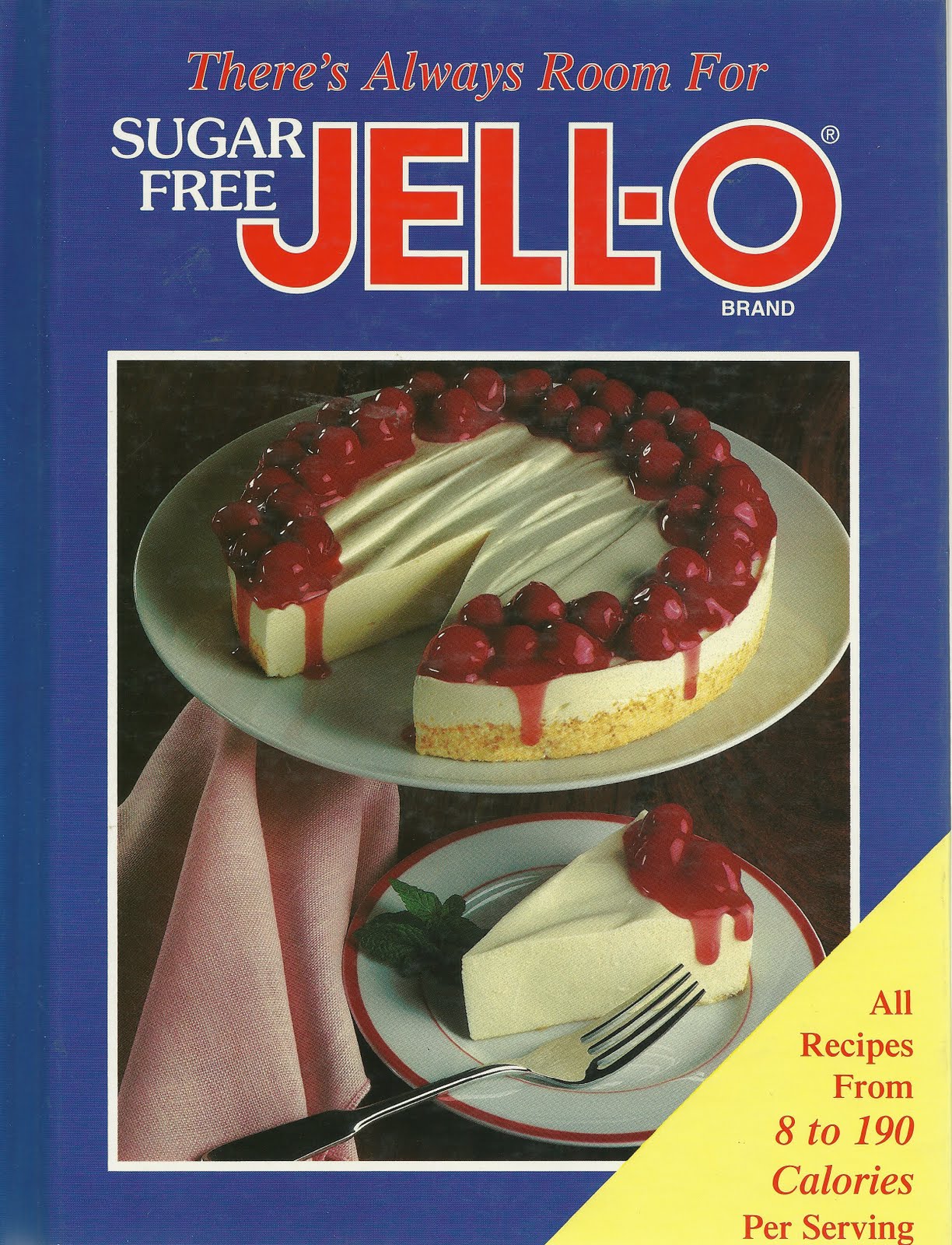
Mix one packet of sugar-free Jell-O with a container of low-fat yogurt and let set. On top of this, stir 1 can of crushed pineapple and 1 cup of shredded carrots into another packet of sugar-free Jell-O. Garnish with lettuce.

There’s Always Room For Sugar Free Jell-O, Publications International, Ltd., 1992

Also from this book: Jell-O and Onions

Friday, February 24, 2012

This’ll Help You Breathe Easier


Sometimes, the most offbeat cures of yesteryear were actually legit. Though how or why they worked might not have been understood, people simply knew that they did work.


Take this treatment for asthma from 1903 that uses pineapple. That probably sounds highly improbable, given that today, with pineapple far more readily available than it was a century ago, it’s not what you’ll reach for first to ease asthma. During an attack, you’re going to reach for the inhaler, filled with albuteral, which provides immediate relief. It was first marketed as Ventolin in 1968.

Pineapples are bromeliads. The pineapple extract bromelian was first isolated in 1891. But bromelian wasn’t promoted as a therapeutic supplement until 1957. Bromelian is an anti-inflammatory agent. Research at the University of Connecticut has shown that this enzyme really does help alleviate the symptoms of asthma.

Go figure.

The Kentucky Receipt Book, Mary Harris Frazer, 1903


Monday, February 20, 2012

The Heart of Pineapple


This is the reason why I affirm that Kurtz was a remarkable man. He had something to say. He said it. He had become affianced to a woman — a dramatic, highly strung woman — who was in possession of the most tragic misunderstanding when it came to fish-and-flavor love affairs. On our long nights sitting in that horrible darkness he told me of a dish she proudly made and served — a pineapple sliced in two and filled with an assortment of shellfish and bacon. She had gone to great lengths to procure the tropical fruit and bid him “eat! eat!” as he sat in stunned silence at the table. She took his speechlessness for wonder, for affirmation that her intuition and instincts were right, that this dish married perfectly flavors only the most civilized of palates could have conjured up, just as she knew in her heart that Kurtz was the man for her, a Godly man, an honorable man, a man not given in the slightest to wretched sadism and degeneracy in the jungle.

As Kurtz recounted this tale, he clutched at his distended stomach with anguish as the night was broken by the cries of an unfortunate being gnawed upon by a crocodile down by the river.
            “Your Intended must love you very much,” I said, concerned only with escaping the conversation. But he was not done. He was in a confessional mood.
            “That was the reason I left Belgium,” he rasped. “The thought of a lifetime of dinners such as that — it’s more than any man could stand. You must see,” he implored, grabbing me by the collar, “the pineapple, it was cleaved in two, and in my mind’s eye — the grotesque pink and glossy flesh of what appeared to be larvae squirmed within.” He shuddered. The effort of recounting this memory seemed to have sapped his strength and sanity. He fell back, quietly sobbing.

When he died, I knew that it was this terrifying memory that besieged him, driving him over the cliff of despair, as we made our way downriver to return him once and for all into the arms of his abandoned Intended. He cried in a whisper at this image, at this vision of Pineapple-Seafood Salad — he cried out twice, a cry that was no more than a breath:
            “The horror! The horror!”

Fish & Seafood Cookbook, Brand Name Publishing Corp., 1985

Also from this book: Creamed Lobster, Hillbilly Sashimi

Thursday, December 15, 2011

Poinsettia Salad


It’s the world’s saddest display of Christmas cheer — a few slices of jelly on a glass plate spruced up with a sprig of parsley just waiting for someone to obliterate them with a spoon, or to simply dissolve quietly over time until all that remains is a brownish puddle in which swim some mangy pieces of a once-proud pineapple. A recipe on the opposite page is called “Poinsettia Salad.” It goes like this:

Arrange a few strips of pimiento on a slice of pineapple that has been placed on a lettuce leaf. Put a marshmallow in the center and top with a nutmeat. Serve with salad dressing.

Do not serve this dish. Don’t make your guests wish you’d served an actual wreath. Also, Poinsettias are very poisonous. Do not name anything edible after them. There is no such thing as a poinsettia salad. It will kill you dead. OK, it won't actually kill you but it won't taste as good as a salad made of lettuce. 

The Ideals Christmas Cookbook, Ideals Publishing Corp., 1975

Also from this book: Shedding Santa

Friday, November 25, 2011

Currying F(l)avor


Once upon a time it was 1959. Life had been so good in the United States after World War Two that everyone in the world wanted to get on the gravy train. Except Fidel Castro, who started off the year by marching on Havana. He’s still there. America had the entertainment of Walt Disney and the Marx Brothers, and its little girls could play with the newly minted Barbie while its boys could fantasize about being astronauts. It’s men could drink and smoke all day long from sun-up to sunset and its women could finally cram their legs into pantyhose after 200 years of wearing stockings.

Russia liked America so much it sold Alaska to it for $7.2 million. The trouble was that Americans didn’t want to go on holiday in the far north. They wanted to sit on tropical beaches and wear bikinis. It was because men wanted to see women in bikinis — a garment named for a beautiful pacific atoll they blew up with atomic bombs a few years before — that they set their sights on the lovely Hawaiian islands as a vacation destination. Hawaiians became Americans and were required to eat turkey on Thanksgiving, and Americans got an endless supply of pineapples.

Cookbooks went pineapple crazy. Now, instead of eating Turkey a la King and Turkey Casserole with the leftover carcass bits, you could have Hawaiian Turkey Curry, a culturally confused mongrel dish consisting of ingredients that could not possibly have all been produced in the same place — the forerunner of pacific rim cuisine. It’s the opposite of the current trend of eating local and reducing your carbon footprint. Hey; it was 1959 — and the world was America’s oyster. I mean melting pot. I mean hot pot. I mean curry.

The world was henceforth America’s Curry.

Rawleigh’s Picture Treasury of Good Cooking, W. T. Rawleigh Company, 1959

Friday, August 19, 2011

Beet-Pineapple Mold and Other Perfect Salads


 In his foundational text on the subject, The Elements of Typographic Style, Robert Bringhurst notes that “typography exists to honor content.” He goes on to say: “when type is poorly chosen, what the words say linguistically and what the letters imply visually are disharmonious, dishonest, out of tune.”

As far as page layouts go, this one isn’t bad. There is proportion, balance, an easy line for the eye to follow. The recipe titles are clear; there is enough white space to lend a certain grace and clarity to the page. The typographer has utilized italics, all-caps, tab spaces and hyphens with a practiced and subtle eye. The page as a whole exhibits classic depths of margin and gutter. Clearly, a professional is at work and we should rightly take a moment to applaud what usually goes — by design — unnoticed. It is typographic poetry.

It’s a damn shame the actual words constitute such shit.

Salad Book, Better Homes and Gardens, 1969
Pin It