>
Showing posts with label Eggs. Show all posts

Sunday, September 9, 2012

Breaking Eggs


Real chefs judge each other not by how well they can cook an elaborate dinner, but how well they can cook an omelet. This, the most simple of dishes, requires every real skill a good cook needs: confidence; the ability to cook an egg;  a light hand with seasoning; working with the right tools and heat; strong arm muscles to heft the pan while cooking, and to tip the omelet out at the end. If you’ve ever ballsed up something so simple, you’ll know how difficult it actually is.

Here’s the delicate flower of American cooking, Julia Child, showing us, in her inimitable way, how it’s done.


You can tell that the omelet is important because in her classic, Mastering The Art of French Cooking, she devotes many pages to breaking down each step, complete with illustrations. Note how the lady in this picture holds the pan. Now, go to your kitchen, and grab a pan just like it. That is, big and heavy. Hold it with one arm just like that.

Now, grab a plate.

Now, pretend you have a fragile omelet in there you have to quickly turn out, without breaking the omelet, the plate, the pan, or your arm.

Mastering The Art of French Cooking, Julia Child, Knopf, 1961

Also from this book: A Spot of (Batter) Bother

Saturday, March 31, 2012

Egg Wash


How long has shampoo been around? A long time, right? Well, hang on — there was that large period of human history in which people didn’t wash, wasn’t there? The Middle Ages? The Dark Ages? Back when they thought ridding the body of its greasy filth was bad for you, right? The era that comes to mind once in a blue moon when you’re clipping your nails and wonder how folks gave themselves pedicures before the invention of nail clippers. Or scissors. Did they chew their toenails off? People were hairy in those days — after all, no safety razors. Before sharp knives, did they depilate with lava rock? Probably. And the teeth — it doesn’t bear thinking about. Compared to the whole teeth (and oh God, menstrual blood) situation, shampooing seems like rather an effete luxury.

Truth is, people didn’t bother with shampoo much before the 1970s — yes, the nineteen-seventies. Farrah Fawcett’s hair went a long blonde way towards convincing women that they needed to shampoo their hair regularly. Shampoo (from the Hindi word, champo) had been around since the turn of the century, mostly in the form of a soap and surfactant, and the Mughals used shampoo consisting of an alkali and essential oils for donkey’s years before that. Originally it meant to massage these oils into the scalp, rather than washing the hair, per se.


So what did ordinary people do before the seventies? They used eggs. The protein in eggs actually makes a wonderful shampoo, leaving the hair all glossy and strong. Egg shampoos are coming back in the expensive salons as an all-natural treatment, but you can always do it yourself at home for dead cheap.

Kentucky Receipt Book, Mary Harris Frazer, 1903

Tuesday, January 17, 2012

Balut-y Hell

The Emperor Penguin eggs


Oates, Scott, Evans
Bowers, Wilson
100 years ago today, Captain Robert F. Scott and his four companions reached the South Pole, only to find they’d been beaten to the goal by Roald Amundsen, 33 days earlier. The photographs taken that day to memorialize the achievement for the record show five very dejected men, all of whom were to die on their return journey. The photographs were taken by Birdie Bowers, pulling the shutter with a string. Birdie Bowers is the unsung hero of Scott’s expedition — intensely loyal, with a superhuman ability to withstand the cold, he was in charge of navigation and stores — that is to say, the food. He was also the only member of the party who had to walk to the South Pole, because he didn’t have a pair of skis.

Along with Birdie Bowers was Edward Wilson, the expedition's chief scientist and Scott’s best friend. Bowers and Wilson had previously survived The Worst Journey In The World, a five-week trek in the middle of the Antarctic winter in total darkness and temperatures of -40c to recover Emperor penguin eggs. The other member of their three-man team, Apsley Cherry-Garrard, was the one who lived to write the book. It was so cold his teeth shattered.

Bowers, Wilson and Cherry-Garrard the night they set out
Wilson, Bowers and Cherry-Garrard the night they returned
Their trek to Cape Crozier, the nesting colony of the Emperor penguin, was one of the more rigorous feats of scientific pursuit ever attempted by man, and it was all in aid of what people claim was the real purpose of the expedition — to advance science (rather than claiming the Pole, though that’s what it’s remembered for). They found, to their dismay, far less penguins than expected, and some of the eggs they carried back with them broke along the way. Only three survived. It was hoped that the embryos inside would prove the missing link between dinosaurs and birds, the Emperor penguin being considered the most primitive bird at the time (due to its ability to survive such inhospitable conditions).

When Cherry-Garrard finally delivered them in person to the Natural History Museum upon his return to civilization, he was told to wait in a corridor. No-one was interested in the eggs. He was told to just leave them at the desk. They weren’t even going to give him a receipt for this treasure that had cost him the lives of his friends, his sanity, and his teeth. As you can imagine, he blew a fuse.


Today, the Natural History Museum feels rather differently. In order to celebrate the centenary of Scott’s death, they are presenting a grand exhibition on him, featuring hundreds of artifacts for the public to gaze upon with wonder — and at the heart of it, something the Museum considers one of its greatest treasures — the Emperor penguin eggs.

Yuckylicious would also like to mark the occasion with a recipe made with eggs. Specifically, the national dish of the Philippines, Balut — duck embryo.


It is worth noting that, generally speaking, any food the locals claim to be an aphrodisiac that improves a man’s “sex stamina” has developed this reputation not because it works, but as an incentive to put it in one’s mouth in the first place. 

Thursday, November 17, 2011

Prairie Oysters


In Season One of the TV show Dallas, THE MOST GLORIOUS SOAP OPERA THERE EVER WAS, JR Ewing fixes himself a Prairie Oyster the morning after a bender. This is because he is woefully hung-over and needs to get himself into shape so that he can go to the office downtown to conduct dastardly business deals of dubious legality and perhaps get it on with one of his secretaries.

The Prairie Oyster is so-named because the raw egg it contains resembles both visually and texturally, a raw oyster. Oysters have long been considered aphrodisiacs, in part due to their slipperiness in the mouth, something the raw egg would appear to approximate. The Prairie Oyster, however, is one of the many names given to bull’s testicles which are breaded, fried and eaten. Eggs are also obviously an essential component of reproduction. The ingestion of another animal’s sexual equipment has also long been an apocryphal method of increasing one’s own sexual prowess. Drinking a Prairie Oyster, then, would constitute a triple-whammy.

Actually downing a glass of brandy and Worcestershire Sauce in which floats a raw egg when hung-over is a challenge only the most steel-stomached drunkard can achieve, meaning that one has to have a rather large set of huevos in the first place.

In the TV show Dallas, THE MOST GLORIOUS SOAP OPERA THERE EVER WAS, the list of principal characters arranged by the size of their cojones (from most to least) is:

Jock Ewing
JR Ewing
Cliff Barnes
Ray Krebbes
Miss Ellie
Lucy Ewing Cooper
Sue Ellen Ewing
Pamela Barnes Ewing
Bobby Ewing

Ray Krebbes, the soft-spoken super-sexy illegitimate son of Jock Ewing, is a cattle rancher, and therefore the only character who is likely to have had experience of actually procuring bull’s testicles, which elevates him far higher on the list than his little brother Bobby, whose name alone implies a child-like innocence and purity in keeping with his role as perpetual underdog.

In case you're wondering why Lucy figures so high on this list, check out this scene, which was part of the storyline where she sleeps with Ray, who turns out later to be her uncle. Also for Pam's gratuitous bum-wiggling shot. 

The House of Calvert Party Encyclopedia, Calvert Distillers Company, 1960


Also from this book: Better Than Anything

Sunday, November 13, 2011

Scotch Woodcock

An American Woodcock. Very sharp beak. Best avoided.

Scotch Woodcock is not what you think it is.

It is not, for instance, something that you might hope to find at the end of a date with a handsome northerner. Or perhaps during the date, if you’re that kind of girl, and happen to accidentally do a little undercover research while adjusting your napkin during the main course. You might decide to skip dinner altogether if you discovered the presence of a Scotch Woodcock while leaning in to say hello with a peck on the cheek.

Do not be put off if your date claims to have a taste for Scotch Woodcock. Scotch Woodcock is not an adult film actor.

Scotch Woodcocks available for private use can be purchased by purveyors of quality game, or rather games. For “games,” read “toys.” They require the occasional rub with oil to prevent them from drying out. Use of normal household polishing agents such as Pledge is not recommended, lest the Woodcock become damaged.

A Scotch Woodcock is also not a reference to a stiff drink, though it may be swallowed, and comes in individual-sized servings. Scotch Woodcock is picked up with the fingers, rather than cutlery, and eaten either as a starter when the appetite requires whetting in preparation for the main course, or afterwards, for a savory flourish. It is an acquired taste that can be a bit messy.

The presence of Scotch Woodcock on the menus of public houses wanting to recapture a bit of the old Pax Britannica glory with antique food should not make tourists think they have wandered into a house of ill-repute.

A woodcock may be enjoyed with a scotch, but that’s something altogether different.

A woodcock is also called a Snipe. Do not let anyone take you snipe hunting. The people who hunt snipe are known as "snipers." It's a term you may be familiar with. There's another reason you should never let anyone — even if they sound sincere — take you snipe hunting, but it's a secret. On a related note, do not let anyone persuade you to hunt for woodcock, or film you doing so for posterity. 
 
SCOTCH WOODCOCK

Ingredients:  The yolks of 2 eggs, 1 gill of cream (or cream and milk in equal parts), anchovy paste, toast, butter, cayenne pepper and salt to taste.

Method:  Cut the toast into 2-inch squares, butter well, and spread them with anchovy paste. Season the yolks with a little cayenne and salt; when slightly beaten add them to the hot cream, stir over the fire until they thicken sufficiently, then pour the preparation over the toast, and serve as hot as possible.

Time: About 10 minutes. Sufficient for 6 to 8 persons. 


Mrs. Beeton’s Book of Household Management

Wednesday, August 24, 2011

Mon Dieu — I’m stuffed!


This picture is a farce — in more ways than the one you’re probably thinking.

You may very well be entertained by the improbable pairings of protein and vegetable; you could even find the elaborate staging of the candle and flowers a satiric example of physical comedy. The poached eggs staring up like twin headlights from their sockets of hulled tomatoes appear to be praying for it all to end in some glorious plot twist. As such, it is a farce in the classical sense.

But it is also a farce in the culinary sense: in the language of classic French gastronomy, the term “farce” means “stuffed,” and these all are. It does shed new light on the Terducken, though, doesn't it? 

Kenmore Microwave Cooking, The Benjamin Company, Inc., 1984

Saturday, August 13, 2011

A Connubial Breakfast


Once upon a time not so very long ago, people married almost total strangers. Sure, they’d been on a few dates, dinner and a movie, and there was probably some chaste kissing at the lady’s doorstep at the end of the evening. After a period of engagement a wedding was had, followed by a reception and then the newlyweds retired to a hotel room to consummate their union before setting off in the morning for a week’s honeymoon.

Imagine the shock of sex after a really busy and emotionally draining day full of relatives in some strange bed with a guy you’ve never seen naked before but with whom you will have to spend the rest of your life even if the sex is horribly bad. Imagine discovering as you lay there all sore listening to him snore like a freight train.

When they return from their honeymoon the groom will pick up his bride and carry her over the threshold of their new home. Suddenly, married life begins without any practice at all and she’s probably already pregnant.

If she’s lucky, she will have been given a household management guide by her mother, which was an encyclopedic compendium of advice and reference for everything the new wife would face in her role as head of the household. Everything from how to buy furniture to how to make curtains to how to clean and what to wear, to cooking and being a hostess was described in detail. Mrs. Beeton had this pretty much covered in the tome that came under her name and was the absolute authority when it came to all things of the matronly persuasion.

If she’s less lucky she will have gotten married in 1965 and been given Happy Living! A Guidebook For Brides courtesy of Sibleys of Rochester, a department store hoping to cash in on all the purchasing it suggests you do. To help, it comes with a Bride’s Gift Record wherein one can list all the gifts one receives and keep track of whether you’ve acknowledged them of not. It’s ambitious; there are numbered lines for 256 gifts.

Among the truly revolting dishes it presents in nauseating Technicolor is this Apple-Beef Ring With Green Bean Succotash that resembles a dog bowl. Husbands must have recoiled in horror.

On the facing page is a recipe for A Connubial Breakfast of ham and eggs because “the bride, unsure of her mate’s morning preferences, might well serve them, for they bring that proverbial bliss.”

We all know what her mate’s morning preference is for "proverbial bliss," but curiously the guidebook doesn’t say anything about that whatsoever.

Happy Living! A Guidebook for Brides, American Bride Publications, 1965

Also from this book: Three Courses (Of Course)Creamed Eggs In A Corned Beef CrustAll For One And One For All!

Saturday, July 23, 2011

Eggs


 This is not, as one would assume, a page illustrating something delicious to serve your guests should you hold a patio party. It is a cautionary tale demonstrating the dangers of putting your pickled vegetables out on the table a tad too early.

Sometimes a busy hostess has other things to do like drinking cocktails, so in the interests of preparedness, she clips the checkered tablecloth to the table, sets out her best glassware, and hurries back to the liquor cabinet.

Over the next couple of days, rainwater fills the bowls, and insects engage in the magnificent cycle of life that has allowed them to flourish for millennia. Here, you can clearly see the eggs that have been laid among the beans and carrots. Worms have infiltrated the jar of mushrooms and and can be spied curled around them.

By the time the guests arrive, the larva will have grown to enormous proportions and demolished the cherry tomatoes. Never fear; a bowl of dipping sauce can be utilized to make them more palatable.

Hors d’oeuvres, Lane Publishing Co., 1976

Also from this book: Cheesy Nuts, A Sticky Situation

Friday, July 8, 2011

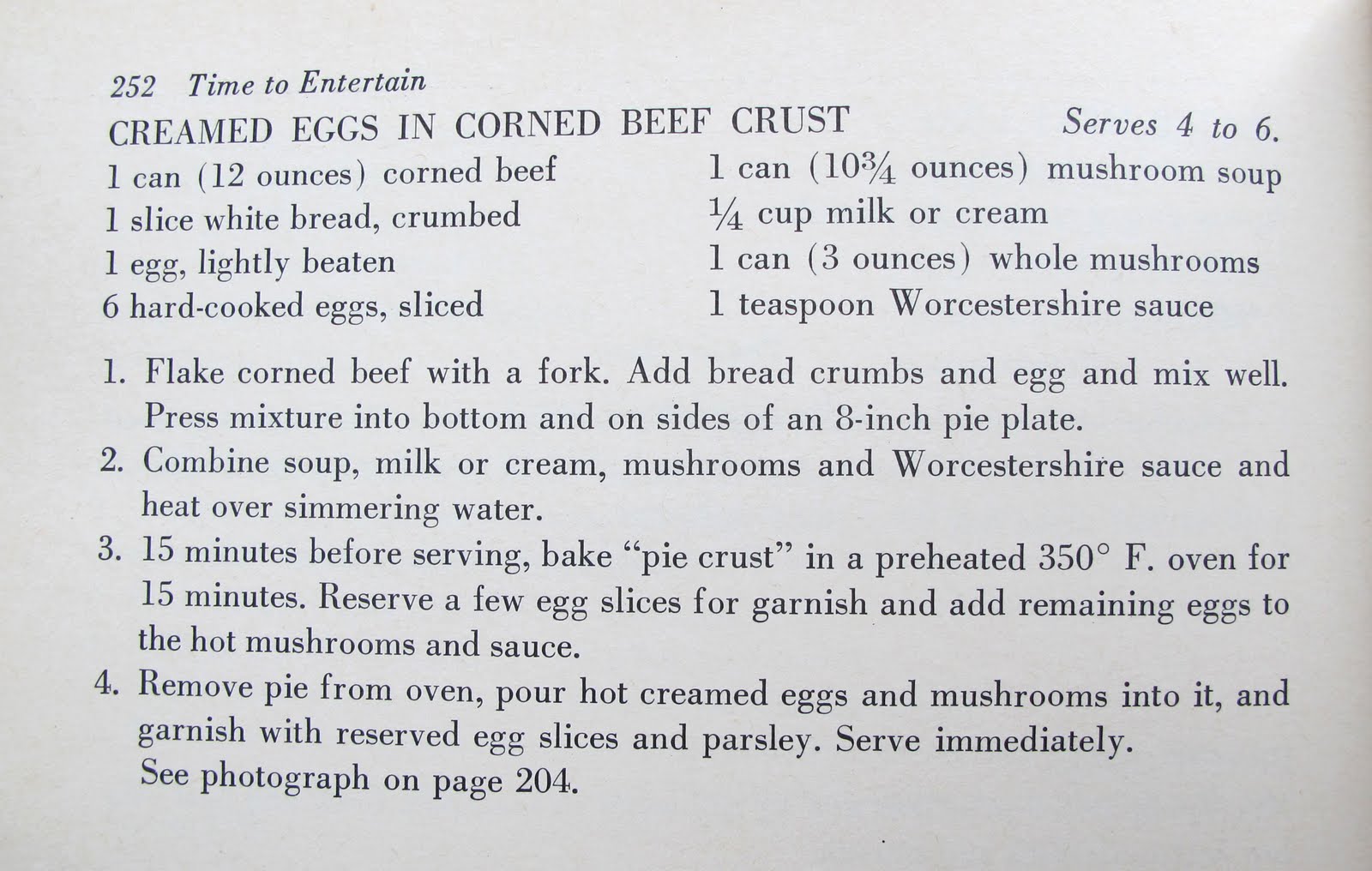
Creamed Eggs in a Corned Beef Crust


I don’t know about you, but when I think of a tart, I don’t assume the crust has been made from meat. This “appetizing” example of what not to do with food features a pie filled with that good old stand-by, mushroom soup. In case the sight of this doesn’t make you retch, the author has cleverly added islands of sliced egg and a sprig of parsley in case the overwhelming palette of browns makes you think no vegetables were involved. Don’t be fooled; they weren’t.

In the photo you can see a cake slice ready to serve this beast. One wonders quite how mushroom soup slices. Surely a ladle is the tool of choice? But then, what to do with the corned beef crust? And do you serve that in a bowl, or on a plate, or what? And what should you eat it with?

The charming composition has been helped along by three crocuses, presumably meant to suggest the Three Wise Men bearing the gifts of —well, something else to look at (there sure is nothing outside that window). It's dinner time! Four to Six whole people can be "entertained" by this recipe. Enjoy! 


Happy Living! A Guidebook for Brides by American Bride Publications, LA 1965

Also from this book: A Connubial BreakfastThree Courses (Of Course)All For One And One For All!
Pin It