>
Showing posts with label Potatoes. Show all posts

Thursday, April 5, 2018

Pizza Potatoes — For When You Simply Don’t Give A F*ck


The Betty Crocker Recipe Card Library series from 1971 is a plastic time capsule of grotesque food photography.

Their food stylists and photographers never met a dish they didn’t shoot on a table set with a dizzying array of additional food accompaniments or props. A heavy emphasis was placed on hardware: the serving dishes, drinking vessels and various pouring devices which crowded their place settings. The food was never enough to speak for itself, always requiring the elaborate costume such clutter provides to suggest an appeal.

The dishes are always shot from an angle which places the card reader at the table — from a diner’s eye-level. The scenes are brightly, but artificially lit and appear to feature real food with a minimum of styling, which on occasion is sorely missed, such as when an element melts, creating an unappetizing look.

Although each and every card is a brightly colored catastrophe, one recipe distinguishes itself as a close-up which should not have been. In Pizza Potatoes, all we see is a gooey mess in a white bowl, with a curve of red tablecloth beyond it, chosen, clearly, to accent the pepperoni swamped by cheese. The interior of the dish is crusted at the edges and gives the impression of a difficult clean-up.

This is not a dish which lends itself to beauty or detail. With our faces just inches from the rim of the bowl, it feels as if we’re leaning in for a sniff. A swampy morass of melted cheese looks like a greasy heart attack, and there’s no hint of a salad to provide any relief. This is a recipe for pizza toppings on top of potato, after all — all of which come from packages supplied by General Mills.


Budget Casseroles Card #25 Pizza Potatoes, Betty Crocker Recipe Card Library, 1971

Monday, December 10, 2012

That’s One Small Latke For Man, And One Giant Latke For Mankind


Latkes: so much time, so many potatoes. The endless grating, the cold, wet potato juice and shredded fingers. The annoying individual-sized portions and the annoying family members clamoring for them.

This year, cut your troubles by making one big latke. No-one will notice if you give them a greasy wedge, or that the potato in the center is raw. Don’t “flip your lid” — let the lid help you flip the latke!

Next year, you’ll save even more time when your family insists on ordering in instead! It’s a win-win!

Vegetables, Time-Life Books, 1979

Tuesday, May 1, 2012

One Potato, Two Potatoes …


— Darling! Hark! Look — I am returned from the market, having bartered with a merchant there for these delicious-looking but mysterious tubers!

— Oh Geoffrey — that’s wonderful news. All I had for dinner was this cauliflower, some asparagus, and a few mushrooms from the patch by the privy.

— Aren’t they magnificent!

— Yes! They look exactly like earthen stones! What did they cost you, husband?

— Edward, the youngest. You’re always complaining about him hanging around.

— Oh, good. Less mouths to feed! Perhaps he will enjoy a better life as a deckhand on some ocean-going vessel and see the world.

— Perhaps he will go to the fabled place where these lumps are grown! What a blessed place that must be!

— I will serve them with my special wooden spoon. Be a dear and rend them open with your axe, will you?

— Why certainly, my beloved. Oh, to live a life on the seas! Swabbing the decks and swaying with the ship! The tropics! Imagine the diseases! I wonder if we shall ever see him again.

— Probably not. Like as not he’ll drown within a month.

— So I’m excited about these spuds. Do you think you’re supposed to cook them or eat them raw?

— How are you serving the rest?

— Raw. I didn’t have time to gather kindling.

— Uncooked it is then, my Sweet. Can’t wait. I’m going to toss a rock around with Ulric.

— Careful, Geoffrey! You remember what happened last time!

— Poor Freddie. He would have made a good seafarer, that boy.

Microwave Miracles,  Hyla O’Connor


Also from this book: Iron Feng, All Wrapped Up, 1982Circumcised Apples

Wednesday, September 7, 2011

Spuds


In the days of yore (1969) cookbooks such as Time-Life’s The Cooking of the British Isles noted that “…in Ireland you will find that, in all probability, Paddy O’Connor eats a lot of fish and potatoes, partly because he is a Roman Catholic, and partly because a lot of fish and potatoes are produced in Ireland … In Kerry, the magic county, the country lanes in the early morning are full of flat-topped carts, each supporting a huge milk churn, pulled by aged horses.”

The author of this totally unromanticized vision certainly has a way with words. He claims that “Scouse, for example, a word related to ‘Scouser,’ a nickname often bestowed on those who admit to coming from Liverpool, is a kind of thin, poverty-stricken stew, said to have been introduced into that city by the Irish.”

According to him the natives prefer it that way — to tuck in to their gruel while dreaming wistfully of being Irish and having the privilege of digging your own peat over which to cook your soda bread because you lack electricity and gas and have no other option for survival. But hey — they “own a donkey and a small boat…so what more did they want?”

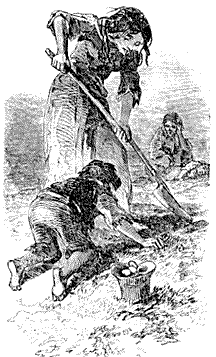
The caption to the photo above reads: “An Irish farm wife and her son dig a few potatoes for supper from their family patch in County Galway. Ever since potatoes were first brought to Ireland from the New World in the 17th Century, they have been a mainstay of the Irish diet.”

Curiously (and predictably) he ignores entirely a little something that happened in the summer of 1845 when Phytophthora infestans arrived like a malevolent tourist on the Emerald Isle’s green and bounteous shores and killed everything it touched.

The airborne fungus reduced healthy potato plants to slime almost overnight — and since by this time the spud had become the staple of a rather meager diet, it literally decimated the population, when over the course of three years one in ten died of starvation.

It didn’t just wipe the humans out; it also ended the long and noble reign of the Lumper potato, which had been the only variety of potato grown, making it exquisitely vulnerable to blight. There are no more Lumpers. The lumpenproletariat, however, clearly survived.

The Cooking of the British Isles, Time-Life Books, 1969

Pin It