>
Showing posts with label Cake. Show all posts

Saturday, May 5, 2018

Marzipan and Sexism


Once upon a time, in a land far, far away, men were married to their jobs, and women were married to their homes — hence the term “housewife.” A housewife’s job was to manage the running of the household, while a man’s job was to care for his all aspects of his employment. While the woman’s title reflected very directly her place in the larger scheme of things (the wife of the house), her husband (for they, too, were married, but in a different sense) was simply called a “man,” denoting his gender. This was because men did men’s things, like working outside the home, while women were defined by their marital status — which included both marriage to a man and marriage to a home. 

Within the home, a housewife was hoped to be extremely competent at a number of tasks — money management (called, confusingly, “husbandry”), decorating, gardening, cleaning, washing, child-rearing, and cooking. In her home, the housewife was a “cook”; she cooked things. If, however, a man engaged in the same tasks outside the home — at work, say — he was known as a “chef,” which means “chief.” He might also be known by any number of professional titles pertaining to the type of “cooking” he did: baker, butcher, etc.

But if a man attempted to “cook” inside the home, it ceased to be “cooking”; his work with foodstuffs became a “hobby.” The one exception to this was the assumption that the man handled any cooking of meat accomplished outdoors, in which case, he “manned the grill.”

In this 1955 Pathé film featuring a baker named Paul demonstrating how to make the ugliest and least-appetizing cake decorations that humankind has ever been subjected to, we find these distinctions taking pride of place in the narrator’s account, for this activity is for “the housewife, or the man who finds it an intriguing hobby.”

Enjoy!

Monday, April 9, 2018

‘Murica


Because nothing screams patriotism like hatchets embedded in cupcakes to recall the evisceration of the landscape and genocide of the Natives who lived in it by white people.

Oh, wait — this is supposed to be Washington’s cherry tree. My bad.


Children’s Parties Card #24 Patriotic Birthday Party, Betty Crocker Recipe Card Library, 1971


Monday, April 2, 2018

An International Incident


In order to make the World Cake for this children’s party, you’re going to need to start well ahead of time and have all your wits about you to avoid World War III.

First, you need to buy two round baking dishes. Sorry: first you need to source two round baking dishes and then figure out how to buy them. Good luck with that.

Next, you have to arrange the initiations. This involves creating  circular invites with plenty of precise instructions. You must “ask each child to dress in the costume of a special country or be ready to tell about one.” Realizing immediately that this proposition is likely to result in the faux pas of two or more children arriving dressed or prepared to tell about the same country, the good folks at Betty Crocker then advise: “it is a good idea to assign countries to the children to avoid duplication.” At this point you must get down on your knees and thank your lucky stars that Betty Crocker does not have a say in International Relations. They don’t even use the phrase “good idea” ironically.

At this point, before you’ve written out those invites, you must sit down and think about which child will represent which country. How ethnographically or politically correct are you going to be? And if you assign the ancestral home of one child, but an utterly alien one to another, what message will that send? What if some kid doesn’t want to be Zimbabwe? And if you avoid this problem by assigning each child random countries, how are they going to know what to wear?

This is when you break open that bottle of Scotch, because you’ve belatedly realized that costumes can’t be assigned to countries, as if countries were singular culturally heterogeneous and sported a “costume.” Come to think of it, how will the whole “tell about it” option go down? Will those party-goers dressed normally be forced to recite facts and figures about their assigned country before they’re allowed in? What if they haven’t done their homework? Pour yourself another glass: you’ve just realized you assigned homework as a condition of attending your kid’s party. You have utterly failed at parenting.

However, you’ve bought the two round baking dishes and cut out 12 globe-shaped invites, so you’re committed. There’s no way out. You consider the games suggestion: “hold a mini-Olympics” and remembered that one of the guests has a broken leg and another has asthma. The “shoe-kicking contest” they also suggest is out then, whatever that entailed.

You decide, three drinks in, to forego the whole United Nations parade, and just focus on the cake, and send out the invites and go to bed.

On the day of the party, you make the cake (not that hard, as it turns out), but discover, to your horror, that you have no idea how to draw an outline of the continents in chocolate icing piped from an envelope onto a spherical cake. You have a hard enough time doing this with a pencil on paper. There is no room for error. Can you pipe and consult a map at the same time? Can you stop the icing from oozing out of the envelope while you do so?

You decide to make the best of a bad situation by disguising the truth of your incompetence by decorating the entire cake in squiggles instead.

You console yourself with the thought that no-one will care.


Children’s Parties Card #6 Far Away Places, Betty Crocker Recipe Card Library, 1971

See Also: A SNAFU In The Jungle, Raggedy Ann Revisited, Horrorscope

Saturday, March 31, 2018

Horrorscope


It had begun innocently enough: Henry’s Mom and Dad welcomed the guests and the parents dropping them off only stayed long enough to find out when to return to pick them up. The kids rushed in bearing their gifts, which were placed on a side table in the hall. Henry, who’d been waiting all day for the festivities to begin, grinned from ear-to-ear as he proudly showed off his new bike. It was purple, and had a banana seat and ape hanger handlebars with streamers.

But once everyone had arrived, Henry’s Mom (she said to call her Doreen) gathered everyone into the living room den and had them take off their shoes and sit in a circle on the shag carpet. Henry’s Dad (he said to call him Frank) turned down the lights and drew the curtains, so there was a lot of chatter, because this could only promise a really exciting game. Doreen put some music on the hi-fi, but it wasn’t party music; it was all sort of swirly. Frank plugged in a lava lamp and took his tie off. “Is everyone ready to learn what their futures hold?” Doreen asked, and all the boys shouted their assent.

Doreen sat down in the circle criss-cross-apple-sauce style and put her hands on her knees with her fingers pinched together, and asked everyone to do the same. There was some giggling, but they did it. Doreen started swaying a little, and then opened her eyes wide and said “Eric!” Eric grinned as his friends on either side poked him.
            “Eric!” Doreen continued, “You enjoy sports! You’re going to play baseball and make it to the major leagues!”
            Eric approved of this future wholeheartedly.
            Next, Doreen shifted and closed her eyes and opened them again and pointed to Peter, who hoped she’d predict he’d become an astronaut, like he hoped.
            “Peter!” she called, “You are into math and have a feel for calculations! You’re going to work at a big tax corporation as one of their accountants!”
            Peter looked dejected.
            “And you’re going to have a really nice car!” Doreen added. This softened the blow.
            “Me next, me next!” the boys shouted excitedly. Doreen moved again, closed her eyes, and opened them on Buddy.
            “Buddy!” she cried. Buddy hopped up and down on his behind awaiting his fate.
            “Buddy — I have bad news for you,” Doreen said. “You will be tempted by the dark side, and lead a life of crime.”
            “What?” Buddy exclaimed, but Doreen had moved on. The boys jostled, uneasy at this sudden turn in events, but expecting it to work out in the end.
            “Alex!” Doreen went on. “Alex, you will be a very successful businessman!” The boys cheered. “You will live in a huge mansion and marry a beautiful woman!” The boys roared. “But it won’t last!”
            Alex deflated. “It’s OK, nudged Ian, sitting next to him, “it isn’t real.”
            Doreen focused her attention on Boris, who stared back silently. “Boris!” She hesitated. “Boris! Your birth mother says she’s sorry, and regrets what she did. She wants me to tell you to avoid the evils of alcohol!”
            “Birth mother?” Boris said. The boys sat transfixed.
            Just as Doreen was about to reveal the fortune of another boy, Frank, who’d been smoking quietly in the corner, interrupted his wife by asking if anybody would like to loosen up a little, to which the party-goers responded gratefully. As they clambered up from the circle, Frank put some new music on the hi-fi and announced it was getting awfully hot in there. Doreen agreed, and started unbuttoning her blouse.
            “It’s the Age of Aquarius!” Frank shouted gleefully.
            At first, the boys were leaping about to the music, but as Henry’s parents began disrobing, the merriment came to an abrupt halt. Henry himself was missing. He must have slipped out.
            “That’s better,” Doreen announced as the last of her clothes came off, as if completely oblivious to the mortified stillness around her.
            “Come on, everybody,” Frank urged, pulling his pants down.

The boys rushed for the door, getting jammed in their rush to escape.
            “Where’s Henry?” Eric cried in a panic.
            They found him in the kitchen staring at his birthday cake. It was bright yellow, with the signs of the zodiac piped around the edge in yellow icing. The center held a sun made out of candy corn.
            “What’s wrong with your Mom and Dad?” Buddy cried.
            “What did she mean, my ‘birth mother’?” Boris kept repeating.

But Henry just sat there looking at his cake.
            “I hate candy corn,” he said. “How come she knows about everyone else but me?”


Children’s Parties Card #5 Age of Aquarius, Betty Crocker Recipe Card Library, 1971

See Also: An International Incident, Raggedy Ann Revisited, A SNAFU In The Jungle

Thursday, March 29, 2018

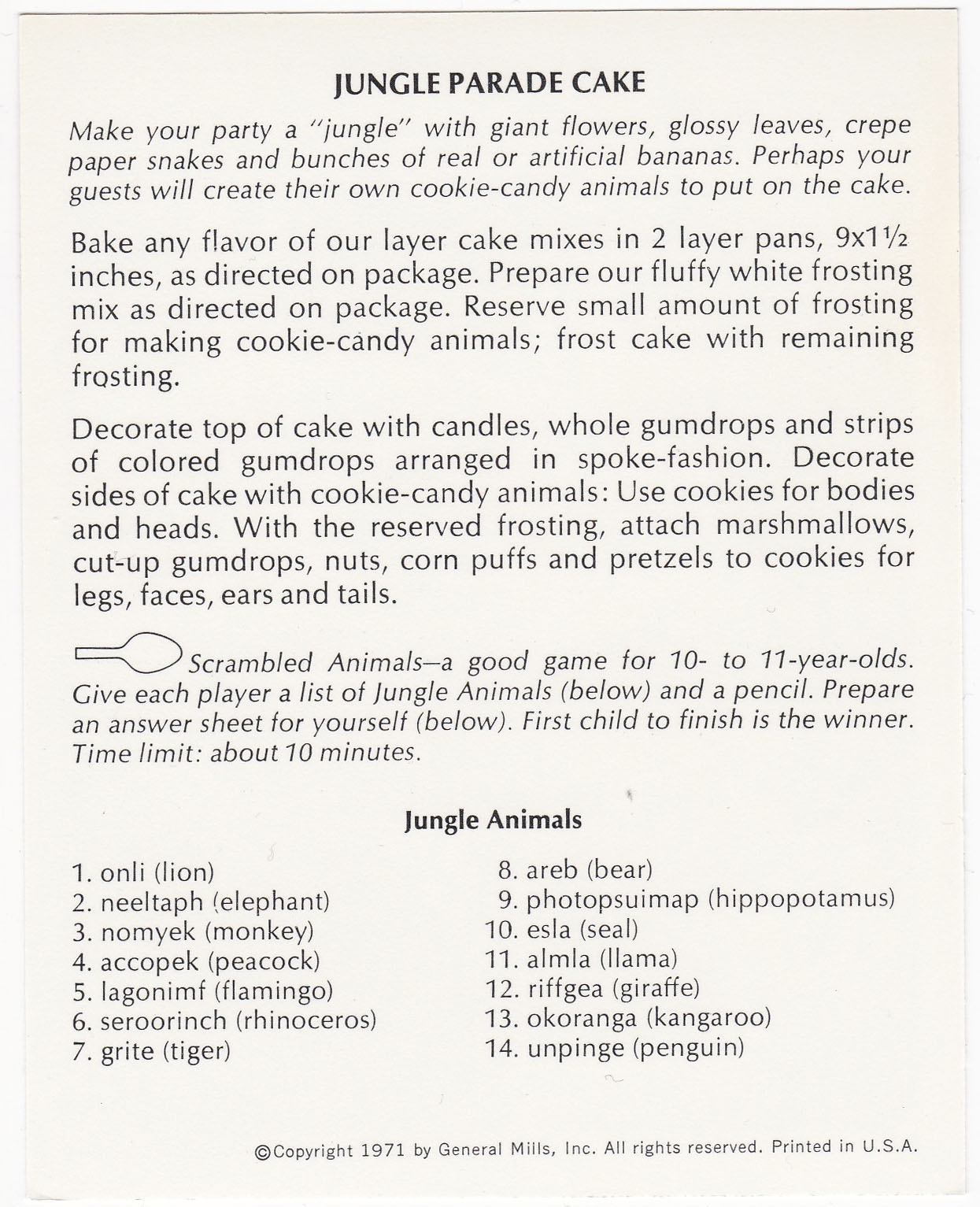
A SNAFU in the Jungle


Nac uoy ared shit? Fo erousc ton.

That’s because in English, we have spelling. Spelling, a thing that schools seem to think is the key to your future success as a human being, is all about putting the letters in the right order. Only sadists and serial killers mix the letters up to hide the message they’re sending — probably just to give themselves more time to commit whatever heinous act they get off on.

On a related note, some mothers take birthday parties a little too seriously. They forget that the only reason little Susie wants a party is so that she can play the Queen Bee and decide which of her classmates she’s going to invite or leave out in the cold as a crystal-clear message they’ve been shunned. The only reason the other kids go is to get high on sugar and run around for two hours and see what presents the other kids brought, hoping that theirs is the best.

The actual details don’t matter, so long as there is cake.


The one thing you want to avoid in planning a child’s birthday party is having it resemble school. This party game devised by the sinister and tortured souls at Betty Crocker hits all the marks:

            involves spelling difficult words 3
            requires writing 3
            is timed 3
            is judged 3
            only exists to kill time 3
            provides ample opportunity for humiliation 3

And to put the icing on the cake, as it were, let’s look closely at what they consider a “jungle” animal:

lion, elephant, monkey, peacock, flamingo, rhinoceros, tiger, bear, hippopotamus, seal, llama, giraffe, kangaroo, penguin.

Penguin, FFS.

This situation is NOT normal — it is all f*cked up.


Children’s Parties Card #3 African Safari, Betty Crocker Recipe Card Library, 1971

See Also: Raggedy Ann Revisited, An International Incident, Horrorscope

Sunday, December 29, 2013

Pablo The Red-Nosed Reindeer


Did you hear about that time Pablo Picasso tried his hand at baking? This is his attempt at a Rudolph the Reindeer cake. 

Creative Cake Decorating, Better Homes and Gardens, 1983

Saturday, October 26, 2013

Will no one rid me of this turbulent cake?


It is said that Thomas Becket, Archbishop of Canterbury, was wearing a hair shirt when he was murdered by Henry II’s knights in 1170. Hair shirts were made from goat hair, their inherent itchiness occasionally enhanced by the addition of twigs, so that their unpleasantness might be a perpetual penance for their wearer. Mortifications of the flesh were curiously popular among the pious of the middle ages, when life in general had its share of painful experiences. The hair shirt, for example, carried with it a living cargo of lice that can only have added to the prickly sensation.

To wear a hair shirt has entered the lexicon as being the action of a martyr. Becket, canonized as a Saint since his gory death, became the object of pilgrimage at the site of his demise, Canterbury Cathedral.

Saint Thomas Becket having his brains spilled
Eating one of these delightful shirt cakes also requires a kind of martyrdom. Imagine, if you will, the rictus of a smile one might adopt upon receiving the gift of such a cake. It’s the same one Becket wore, no doubt, upon seeing the assassins approaching him with evil intent in their eyes. “Why hello good sirs,” he probably said, scratching his chest. “What brings you to church at this ungodly hour?”

How different history might have been if instead of slicing the top of his head of by means of reply, they’d simply said “Ta-da! Cake!”

Creative Cake Decorating, Better Homes and Gardens, 1983

Also from this book: Pablo The Red-Nosed Reindeer, Mother's Day

Wednesday, August 7, 2013

Peanuts and Insect Parts


One of the more curious medical conditions of modern times is the peanut allergy. For those who break out in actual symptoms, it is a real threat whose potential outcome can be death. We all know of schools with peanut-free classrooms, and airlines no longer serve peanuts with their drinks (or pretty much anything, but that’s another story) to avoid troublesome lawsuits from people whose sensitivity is so severe that the mere proximity to peanuts can set them off.


Numerous studies have been done to determine what the cause of such a widespread allergy could be, and the results are — well, unclear. The only thing they have found is that a large percentage of peanut allergies appear to be psychosomatic in nature; that is, all in the mind. Even a minor sensitivity can be made physically more severe if the sufferer thinks it’s going to be. In fact, on average, only ten people die each year from a peanut allergy. Sucks if you’re one of them, but that’s out of millions and millions who claim to have a peanut allergy.


In the US particularly, candy bars are heavily peanut-based. Chain restaurants always feature one or more peanut butter flavored dessert. Peanut butter and jelly sandwiches are the de facto food for children who are picky about eating anything else.


Peanut butter at its most simplest consists of roasted peanuts ground to a paste. But the best-selling brands in the US give you much more than that.

Jif,  Skippy, and Peter Pan brands all contain hydrogenated oils, mono and diglycerides, molasses, sugar and salt.

There’s also this:

The defect guidelines on food exposed to biological or natural contaminants establishes acceptable levels of defect. According to the FDA Food Defect Action List, peanut butter is allowed to have an average of 30 or more insect fragments, 1 rodent hair, and 20 milligrams of grit in 100 grams. An 18-ounce jar of peanut butter is 510 grams. What this means is that you could find an average of 150 insects parts, 5 rodent hairs and 125 milligrams of grit in your 18-ounce peanut butter jar.

Mold, insect fragments, excrement, maggots, and rodent hair, sand, wood, and fiber have set levels allowed in peanut butter. Samples that fall under the set levels pass inspection and are allowed to be marketed.


In case that gives you the willies, you could always make this cake. In 1959, whoever made it decided that sticking peanuts in their shells on toothpicks around the edge was a good idea.

Holiday Cook Book, Better Homes and Gardens, 1959

Also from this book: Lincoln Log

Tuesday, August 6, 2013

Lincoln Log


When you see a set of Lincoln Logs — or anything built with them by a child — you probably don’t immediately think “Frank Lloyd Wright!” And yet they were invented by his son John in 1916, and modeled after the eminent architect’s design for Tokyo’s Imperial Hotel. The hotel was built to withstand earthquakes, which it did admirably.


It is curious then, that Lincoln Log kits are so clearly reminiscent of the kind of frontier houses that President Lincoln was born in. Originally, sets came with instructions for building a future president’s log cabin as well as Uncle Tom’s Cabin. Hmm.


While logs that link sound like “Lincoln [linkin’] Logs” and thus create a neat auditory knot, we don’t usually associate them with cake.

The original Mr. Log
But if you want to make a house out of cake, you may very well use this recipe for Lincoln Log — a jelly roll and ice cream concoction that Lloyd Wright might not exactly deem earthquake-proof.

Holiday Cook Book, Better Homes and Gardens, 1959

Also from this book: Peanuts and Insect Parts

Wednesday, February 20, 2013

Insouciance


Got company coming over? A ladies luncheon or coffee morning? Or a date with your mother-in-law? Perhaps you’ve invited the new neighbors over to introduce yourself.

Should you be compelled to entertain, but find that for whatever reason, you just don’t give a f*ck, then this is the perfect thing to serve. It says “I went to the trouble, but didn’t trouble myself too much.” It’s semi-homemade in a way that signals you’re a busy woman who wants to keep up appearances, but hasn’t got time to appear to keep them up. A dessert such as this acknowledges that you like tradition in the kitchen and fashion in the dining room. It says “I understand the fundamentals but like to throw them together according to my mood.”

Whatever message it sends, it’s sure to please the unfortunates among your crowd who will feel encouraged to gorge now and purge later, or perhaps to decline to indulge themselves at all in order to maintain their figures. You can go ahead and give it a fancy French name. No-one will know what it means. 

Dessert Cook Book, Better Homes and Gardens, 1960

Tuesday, December 25, 2012

Our Father (Christmas), Who Art In Heaven


The basic premise of Christian theology is that the life you lead on Earth will determine if you spend eternity in Heaven, or Hell. Different doctrines hold that either your ultimate destination is predetermined and there’s nothing you can do about it; or that you’re given a last chance to renounce your sins and be granted a pass to the glorious afterworld. Still others say that you’re being watched and judged every single day, and that your behaviors have a cumulative effect, like an end-of-year grade, weighted according to your overall piety. St. Peter is traditionally seen as gatekeeper, for whom you must pass muster to be let inside the exclusive club.

On the other hand, Santa does the very same thing at Christmastime, a fact millions of children or people who have once been children, can attest (there are even picture to prove it), which begs the question: is Santa St. Peter in disguise?  

“Ho ho ho,” the big man with a beard will murmur merrily as you approach, trembling amid the whiteness. “What’s your name, little [BOY or GIRL]?”

At this you will tell him your name. Probably your formal name, the one on your birth certificate, as opposed to the nickname you have been known by your whole entire life.

“And tell me,” the portly fellow will huff, “have you been naughty or nice?”

Naturally, you’ll report having been nice. Very nice, in fact. Super-nice.

The imposing gentleman will peer at you to confirm your confession’s veracity, because he has super powers and can determine such things. “Fair enough then,” he’ll snort, “you can come in. Close the door behind you, you’ll let in the draft.”

Christmas!, Wilton Enterprises, 1992

Also from this book: Santamas

Wednesday, June 13, 2012

Let Them Eat Cake!


Poor old Marie Antoinette: it’s not enough that she had to powder her hair mauve and sculpt it into fantastic shapes, or that her young husband was a dud in bed, or that her head was lopped off in the French Revolution. She is also remembered for a phrase she never uttered, the bitchiest phrase since “speak to the hand,” or “whatev” — “Let them eat cake.” The phrase was “let them eat brioche,” and no-one really knows who said it or when or why.

What is clear, however, is that none of these are the kind of cakes she might have had in mind had she been around to utter such a thing. Marion Harris Neil, the author of Mrs. Neil’s Cooking Secrets and about a gazillion other highly useful and efficient books on household management and cookery, was the Proletariat version of Queen Marie. These are some of the delicious cakes she wanted people to bake.


Mrs. Neil’s Cooking Secrets, The Procter & Gamble Co., 1924

Thursday, June 7, 2012

Rococo Cocoa


If you had arrived in Vienna in 1730, weary from your travels upon a donkey, and stopped at an inn for a crust of bread and some hot chocolate to refresh yourself, this is what you would have been served. Blimey, you would have thought, that’s a tad excessive.

People back then were stucco crazy. Everywhere you looked, great dollops of the lime, sand and water mixture had been applied to every surface. White was all the rage. Even people made themselves whiter than they already were by powdering their faces and hair, the men sporting white wigs while the women crafted elaborate hairdos supplemented by hairpieces, which were then powdered white-ish (not to be confused with the men).


Food was not immune: fantastically crafted pastries and sugar follies graced tables, mimicking the architectural detailing all around. It was the age of the spatula, the trowel, and the star-shaped icing tip.

The only thing that wasn’t white were teeth.

There was nothing else for the wealthy to do. There was no TV, sports or scrapbooking to keep them occupied.

All this excess had its downside, however, because the peasants thought it a bit frivolous. They revolted, and chopped off all the be-wigged heads. Marie Antoinette is (erroneously) credited with suggesting the starving masses eat cake if they had no bread. Not, perhaps, the best bit of advice. The revolutionaries replied with the traditional response to such things: “suck on this!” 

The Cooking of Vienna’s Empire, Time-Life Books, 1968

Also from this book: The Butcher of Dubrovnik


Thursday, April 12, 2012

Thomas Kincade: Painter of Cakes


It is generally thought that the late Thomas Kincade called himself the “Painter of Light” because he wanted to steal the reputation of history’s first painter of light, JMW Turner — a connection Kincade was happy to promulgate.

However, it is a little known fact that he came up with the moniker (which he protected with a trademark) after spending his formative years as the “painter of cakes.” Working in frosting and fondant, he developed the skills upon which he built his empire.

Connoisseurs of his work will recognize Kincade’s signature handling of saccharine subject matter and subtle coloring, as well as the realism inherent in his trees and landscape work. It was while working at the bakery that he got the idea of becoming a “chocolate box” painter instead of simply painting chocolates.

Easy Cake Decorating Cookbook, Mildred Brand, 1980

Friday, March 30, 2012

Booze Cake


— Ed, you know who that was at the nametag table?
— No, who?
— Mrs. Pollard.
— Who?
— Sue Pollard’s mum.
— Good Lord.
— She was a cracker, wasn’t she, Ed?
— She was that.
— I loved that woman. I wanted to marry her. I wanted her to be my mom too.
— That’s not how it works, Steve.
— You know what I mean, don’t tell me you don’t. How old were we?
— 12.
— Right. How old was she?
— Somewhere between 30 and 35 I should reckon.
— But she looked so much younger, didn’t she?
— She looked inebriated, most of the time.
— You’d go round to Sue Pollard’s house to play and she’d offer you a drink. And you’d say thanks, and instead of milk or juice she’d hand you a snifter.
— She didn’t want to drink alone.
— She was handy in the kitchen though — you couldn’t fault her. It wasn’t like she was falling down drunk. She always had something baking.
— She was a functional drunk.
— Like us?
— Like us.
— Remember that birthday party where she served that cake and all the kids fell asleep?
— The booze cake! Oh, man.
— Whatever happened to Sue Pollard?
— She got married, like the rest of us. That Wiecher guy.
— Which Wiecher guy?
— Him, over there. The one with the ridiculous suit.
— If he’s here, how come Sue isn’t?
— Divorced, probably. Like the rest of us.
— I hate these things. Why do we come?
— Don’t know. Maybe meet someone.
— Never gonna happen, my friend.
— I really want that recipe for that booze cake.
— Seriously?
— Absolutely.
— Go for it. Ask her.

The Golfer’s Cookbook, Rose Elder, 1977

Tuesday, February 28, 2012

The Ephemeral Gladys LeBlanc


Gladys LeBlanc always loved to write. As a girl she spent hours carving her name into the sand with a stick, often racing to complete it before the tide washed it away. In her years as a teacher at Underhill Elementary she gained quite a reputation for being able to squeeze an enormous amount of writing onto the blackboard before lack of space forced her to have to erase it from the top. Her hand was very difficult to read, and the students would complain, but she’d tell them to bite their tongues. During assembly, she could often be seen with a finger held to her mouth to get the children to hush, especially during the prayer, when chattering was frowned upon.

Gladys met her husband Everett at church, where she sang in the choir, every Sunday sending praises into the air to be heard only for a moment before being lost to silence and the sound of shuffling feet. Everett’s family had come from France and all spoken French, but none of them spoke it anymore, especially Everett, who wasn’t attracted to her voice because he was born deaf.

Gladys found this to be somewhat of a relief after her last venture into amore — an affair conducted entirely in the form of letters sent to an airbase where her beau — a pen pal named James — had been stationed. She had hoped this would lead to marriage once he was sent home — it had seemed that he was full of promises in that regard, but things aren’t always what they seem, and it turned out he was quite the wordsmith, playing the field with several ladies in her small town from afar. His empty words all went up in flames in the fireplace after Ethel revealed that she too had hoped one day to become his wife. Ethel was a gossip, so Gladys stopped confiding in her.

After her marriage Gladys worked part-time as a copy-editor for the local paper, armed with a red pencil with which to strike through lines of text that did not suit the paper’s style. Never use twenty words if you can say it in ten, her supervisor always said, forever on the lookout to save column space for ads. In her spare time, she liked to do the crossword, so avoided passing the desk of the setter so she wouldn’t accidentally get a glimpse of the answers in advance.

Life with Everett was quiet, and eventually she stopped humming while she worked on learning sign language, an art that mystified her but in which her new husband was fluent. After some years she found she could keep up with what he and his deaf friends were saying, but always felt like an outsider, sure that at least some of the signs they used were not suitable for a lady’s eyes. Once, while turning the mattress, she found a gentleman’s magazine hidden there, which she threw away and never mentioned.

Everett worked for the local authority as an odd-jobs man, and thanks to a spate of vandalism spent most of his time scrubbing graffiti off lavatory doors and walls. On Saturdays he kept the scoreboard for the local baseball team — not being able to play himself due to the deafness — constantly hanging and re-hanging scores and keeping track of outs and runs on a little notepad so he wouldn’t get lost. After the game, he’d tear the page off, roll it up into a ball, and pitch it into the bin.

Gladys and Everett were blessed with a son who grew up to be a typesetter for the paper, always coming over for Sunday dinner with ink-stained hands from cleaning used type. He took Gladys to his office once, to show her how it worked — the trays of metal letters and blocks for spacing, each one having to be arranged individually and disassembled after the print run. Gladys was left speechless at the thought of having to learn where all the letters were in so many small compartments. This was before the linotype machines arrived and the great cases of alphabets and glyphs were carted off to the dump, of no use to anyone anymore. Occasionally, a child would come home clutching a handful of Baskerville and a bit of Caslon that had washed up along the banks of the river, but their mothers would invariably throw them away again.

It wasn’t until Everett retired that Gladys started doing cakes. The bakery found it had more business than it could handle, it being an aging town and having so many funerals to cater. For some reason, the Bible verses caught on — they were cheaper than getting something printed for a wreath — and served to fill the bellies of the bereaved. Gladys relished the work — sometimes two or more cakes a week — squinting over them with food coloring and a toothpick, though it was always sad to be reminded of a voice she had once spoken many of these verses with at church meetings being snuffed out.

Often, Gladys was asked to attend the wake, and thus had to eat her own words, though she was always careful to save the slice that spelled out LOVE, taking that home to Everett, wrapped in a napkin printed with the funeral home’s name. 

Easy Cake Decorating Cookbook, Mildred Brand, 1980

Also from this book: Stop Clowning Around, Frosting The SnowmanThomas Kincade: Painter of Cakes
Pin It