>
Showing posts with label Pudding. Show all posts

Monday, June 4, 2012

Spotted Richard


The classic British steamed pudding which gets its name from the raisins speckled within it — Spotted Dick — is perhaps the most famous of all desserts which bring a blush to the cheek. Such has been the embarrassment caused by the name of this dish that certain restaurants have taken to calling it “Spotted Richard” on their menus, which only seems to draw attention to the issue, rather than diffuse it. “What’s a Richard,” a hapless (or troublesome) customer might ask. “Why, it is a dick,” the waitress might say. “Why don’t you call it a dick, then?” the customer might pursue. “Because we feel ‘Richard’ is less controversial,” the waitress might respond. “How so?” the puzzled customer might ask. “Well,” offers the waitress, hesitatingly, “dick means penis.” A mighty silence might befall the ensemble while this riveting piece of news sinks in. “So why is the pudding called a spotted penis?” the customer now bravely asks. This is the critical juncture where the waitress throws up her hands, shrugs, and says “damned if I know. You want it or not?”


In fact, Spotted Dick probably gets its name from a corruption of the word pudding, which if you’re from Souf London you’re pronounce “puddink.” Don’t ask why. Dink becomes Dick, most likely because the English have always been prone to a bit of light and bawdy humor given the rain and general misery, and the chance to have a perfectly innocent conversation in which you can confess to enjoying eating spotted dick without recrimination is too good to pass up.

But it isn’t the dick part that’s most interesting here.

It’s the spots.

A spot, meaning a moral stain, dates all the way back to 1200. A spot of land dates from a hundred years later. But spot, from the Old English splott, also means blot, as in a blighted bit, as when one blots a pristine piece of paper, or a blot on the landscape. To spot, as in to locate something, dates from 1300. To spot, as a verb, meaning to sully, or stain, dates from the early 15th century. A blemish spot comes to us from the 16th century.

One could be spotted having a spot of Spotted Dick in a lovely spot and not get spots from it.

Freezer Feast, Caroline Rennie, 1973

Friday, March 9, 2012

Brown Betty


Oh Brown Betty, bam-a-lam
Take your apples Brown Betty, bam-a-lam
Stew em up real good, bam-a-lam
Oh Brown Betty, bam-a-lam
Stir em round Brown Betty, bam-a-lam
Round and round Brown Betty, bam-a-lam

Oh Brown Betty, bam-a-lam

Take your crumbs Black Betty, bam-a-lam
And your butter Brown Betty, bam-a-lam
Oh Brown Betty, bam-a-lam
Mix em up in a pan, bam-a-lam
Crumbs first Brown Betty, bam-a-lam
Bake it good Brown Betty, bam-a-lam
Bake it long Brown Betty, bam-a-lam

Oh Brown Betty, bam-a-lam

Serve it up Brown Betty, bam-a-lam
With some cream Brown Betty, bam-a-lam
Oh Brown Betty, bam-a-lam
I love you Brown Betty, bam-a-lam

Rumford Complete Cook Book, Rumford Chemical Works, 1908


Friday, March 2, 2012

Devil’s Food Pudding


The Vatican, Vatican City

— Let us convene. We have before us today a pudding made of chocolate that is being considered for beatification.

— Father, isn’t it a bit out of the ordinary to beatify food items?

— Not at all. Just think of all the appearances of Jesus on bits of toast.

— Toast?

— Certainly. Bread is the body of our Lord after all. Who is this amateur? Who let him in?

— Why, I am the Devil’s Advocate, Father. Essential to the process and all that.

— I thought we’d done away with your kind.

— Not so much.

— Let’s get on with it then. Why is this pudding deemed blessed?


— Because it is made in a tin can, Father, and thus provides the poor and wretched with a nice bit of dessert.

— Fair enough. What say you, Devil’s Advocate?

— This pudding is not remotely suitable for such lofty praise. It is flavorless and dry. We serve it at the canteen in Hell as a matter of fact, instead of molten chocolate cake, which is what people usually expect, because it’s so sinful. We call it Devil’s Food Pudding.

— Oh dear.

— We also serve Devil’s Food Cake and Devilled Eggs.

— But I love devilled eggs!

— And so you should, Father.

— Well it looks like a closed case then. We can’t beatify a dish served in Hell. It would wreak havoc upon the faithful.

— We also serve toast, Father.

— What!

— Dry, of course, and rather burnt.

— We’ll overlook that.  Is anyone staying for the fish fry tonight?

— But doesn’t fried fish require using the batter that Shrove Tuesday’s pancakes were supposed to use up for Lent?

— Isn’t your job done?

— I’m never really off the clock, no (attorneys never are).

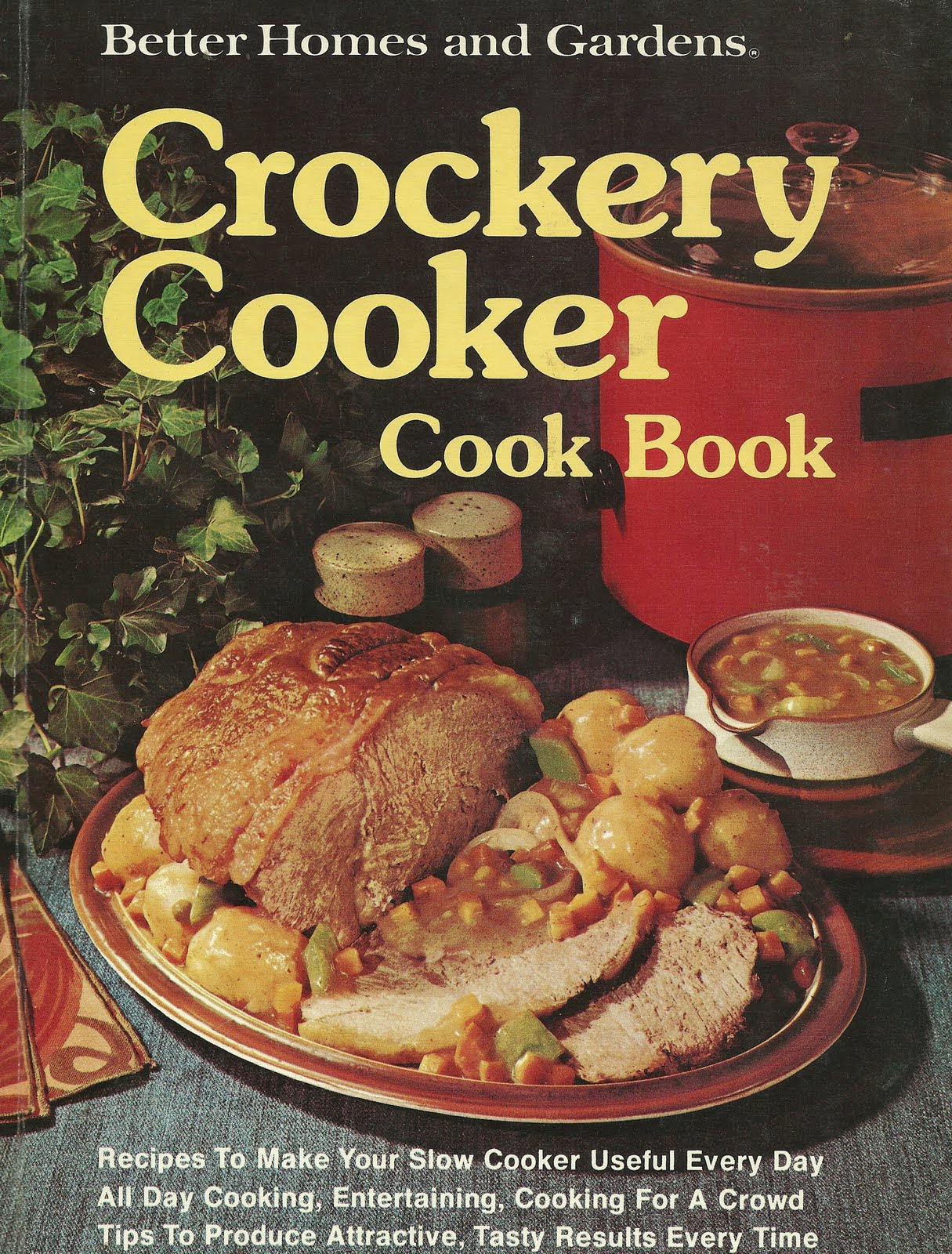
Crockery Cooker Cook Book, Better Homes and Gardens, 1976

Also from this book: Cherry Pork Chops of Doom

Pin It