>

Sunday, October 30, 2011

Stop Whining


Wine: a mysterious and forbidding drink that must be approached with trepidation and reverence, for who knows what horrors might await the unprepared soul who takes a sip!

Wine is complicated, fraught with potential for disaster. What if you choose the wrong one? What if you pick a bad year? What if you can’t get the cork out? How can you tell if it’s gone off? At what temperature do you serve it? How do you store it? Do you have the right glasses? How much should you pour? How do you hold the glass – by the bulb or the stem? What if you don’t like it? Do you have to swirl it around and do that strange mouth-swash thing when you take a sip? Must you describe it with a rarified, codified language that makes no sense? What is a bouquet, and must one also present it to the hostess? Come to think of it, how does one give a bottle of wine? In a paper bag? In a box? In a velvet sheath? And should the hostess open the bottle you bought or one she already has on hand? Why is wine that is actually red in color bad? How come it’s called “red” then, and not “burgundy,” or “claret”? It is? Why is wine that is called “noir” not black then? What wine should you drink with which course? What’s up with those bottles woven in straw, and why did people cram candles in them? Is wine that comes with a screw-top bad? What about plastic corks? Do you have to wear a smoking jacket to enjoy wine? How much is too much? Do people still stomp on grapes with their bare feet to make wine? That’s nasty.

Wine in Cooking and Dining, Culinary Arts Institute, 1976

Saturday, October 29, 2011

Very Game


A game is a diversion undertaken for entertainment purposes, sometimes in order to teach a lesson, in which the participant(s) compete using mental and physical skill to reach a goal. A game can also be a con; a swindle. A gamer is one who plays games, or in contemporary parlance, engages in playing screen-based games, with him or herself and/or others. Game describes a target, as in “fair game” who has been selected for some kind of attack. Game is also the name for wild animal protein which requires hunting. Gamey refers to meat that has gone “off” or begun to taint, producing a richer smell and flavor. To be game is to be up for a challenge, especially if it involves a certain amount of personal risk. To endure or proceed gamely is to eschew such risk, often for the good of the group; to be a good sport.

The process of recovering venison which has begun to stink into a palatable meal, and then eating it, perhaps with your family, involves all of the above. It features gamey game being prepared gamely as a game, and consumed by game gamers gamely while engaging in what surely is a game game.

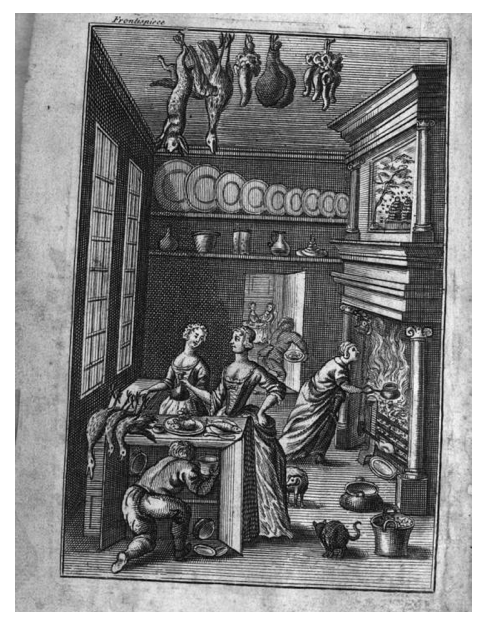
The Compleat Housewife, Eliza Smith, 1742


Friday, October 28, 2011

Not Mastering the Art of French Cooking


 There are many ways to present recipes in cookbooks designed for people who need instructions on how to cook. It’s helpful, say, to provide a list of ingredients up front, and layout the steps clearly so that the harried cook can find their place easily when glancing at the open page while stirring the pot. This book scoffs at all of that. “The secret is in the timing,” the introduction claims. No it isn’t: the secret is in the design.


For a start, this is a paperback. It does not stay open; it’s even hard to crack open when holding with both hands; it would be necessary to break the spine in order to see what lies in the gutter.

The gutter, deep in the fold (the most difficult part of a book to see), is where all the action is: the glorious “Timer” that allegedly provides an easy to follow timeline upon which the book is based. It’s punctual to the minute, as if any individual amateur cook could possibly stick to such regimentation! What would happen if you fell behind?


The text to the side is so small and crammed together that it’s impossible to find your place in a hurry. One side contains so much instruction while the other remains blank.


Finally, at the end, is a menu with a comprehensive list of all that you’ll need: why isn’t this at the front?


Chessy Rayner, New York style icon, was known for her eclectic yet simple design — in fashion and decor. It’s a mystery how she could get this so wrong. 

French Cooking By The Clock, William and Chesbrough Rayner, The New American Library, 1965


Thursday, October 27, 2011

Scrapple


Some recipes have too much information; some, too little.

This one switches between the two. It’s full of adverbs where you need them — you must clean the head “thoroughly,” simmer it “gently,” stir it “constantly,” cool it “slowly” and watch it “carefully” — and rubbish when you really need them.

How should you “separate” the head into halves? With a saw? A cleaver? A machete? Vigorously? Responsibly? Angrily? And how does one take out the eyes and brains? With your fingers? A spoon? A pick? Tongs? Greedily? Delicately? Matter-of-factly?


In a related matter, Scrabble is the most perfect board game yet devised by man. It requires something of beauty to be made from the scraps of alphabet. It should be played mercilessly, competitively, joyously, and often.

Berks County Cook Book, (date unknown)

Wednesday, October 26, 2011

Pacific Rim Job


Captain James Cook once said he wanted to go “farther than any man has been before me, but as far as I think it is possible for a man to go,” a sentiment echoed by an adventurer inspired by him, Captain James T. Kirk, whose mission is: “to explore strange new worlds, to seek out new life and new civilizations, to boldly go where no man has gone before.”

In 1779, the former took this ambition a tad too literally and went, indeed, further than it was possible for him to go. Landing for the second time in Hawaii, where he and his crew had been welcomed as strange white gods, he found to his dismay that the season of worshipping great white gods had passed. Thence followed a classic example of what not to do when one finds oneself on hostile territory: when some of the natives stole a boat, he tried to take their king as hostage, and in doing so, made the fatal mistake of turning his back on the angry hoard. He was swiftly bonked on the head, stabbed, disemboweled, burned, and his bones cleaned for use as relics. 

This put an end to his distinguished career as England’s foremost explorer.

Cook initially named Hawaii the Sandwich Islands, after one of his benefactors, the Earl of Sandwich. Perhaps the Hawaiians were piqued to have their glorious island chain named after such a lowly dish. Perhaps they took him at his name. Hereforth some advice: do not name a place after the way you plan to be eaten by the people living there.

Two hundred years later, insult was added to injury when Homes and Gardens published this recipe for the “delectable” Chicken Aloha. It brings together a vicious combination of cubed chicken, celery, peppers, soy sauce, instant bouillon granules and a can of pineapple pie filling, garnished with parsley and kumquats, all served on a bed of crispy Chow Mein with coconut and slivered almonds on the side.

“Aloha” means love and peace, and is often used as a greeting in Hawaii. Cook met his end on Valentine’s Day. A coincidence?

Meals in Minutes, Better Homes and Gardens, 1973


Also from this book: Planned Overs, Ham Sandwich Deluxe

Tuesday, October 25, 2011

Fried Brains


— Darling, I’m starving! What’s for dinner?

— Your favorite — brains!

— Oh yummy!

— How would you like them, dear? I have so many recipes I can’t decide.

— You know how I like them: fresh and bleeding.

— I have plenty. I’ve had no trouble getting them since the Apocalypse.

— The butcher we had before was rubbish.

— I know — really chewy, and he kept scratching.

— He left a nasty taste in my mouth.

— His wife was nice. But she's not there. 

— The new butcher is much better.

— Yes, he’s tender and delicious.

— He’ll give you anything you ask for. These brains, for instance. I believe they were his son's.

— Well, that’s jolly nice of him. Sweetheart, gimme a kiss with those lovely lips of yours…

— Here they are, but take them quick; I need my hand to stir the pot.

— Gotcha!

— Here: eat up. A mind's a terrible thing to waste. 

Cooking for Young Homemakers, Culinary Arts Institute, 1948

Also from this book: Roast Opossum, Fried and BakedCrown Roast of FrankfurtersRudolph the Red Nosed Pot Roast

Monday, October 24, 2011

Bomba the Jungle Boy and the Pizza of Death


Bomba the Jungle Boy, a character invented by the Stratemeyer Syndicate (not a crime family) and published under the pseudonym Roy Rockwood (not a gay porno actor), was a direct imitation of Tarzan (of the Apes). Bomba, a white orphan who grows up under the minimal care of a naturalist named Cody Casson (not Wild Bill) in the jungles of South America feels more kinship with his animal friends than his dark-skinned compadres/enemies and longs to discover the story of his English parents. He meets with many adventures along the way with extreme bravery, dressed in his puma  skin tunic and armed with a razor-sharp knife. Eventually he runs out of dangerous situations in the New World so he ends up getting up to much derring-do in Africa instead.

 Bomba doesn’t so much ante-date Tarzan as he pre-dates Elmo (of the urban jungle) in his actions and speech. “Me Tarzan, you Jane” establishes Lord Greystoke’s pidgin English, but at least he speaks in first-person, therefore demonstrating his awareness of personhood. Bomba, by contrast, generally speaks in third-person: “Bomba is glad,” except for when he feels compelled to demonstrate his origins, when his facility with the language improves spectacularly. There is little charm in the appalling racism, but much in the vocabulary of 1929: they are all going “yonder” and “athwart” and express “jubilation.”

Any recreation of Bomba for contemporary readers would do away with the Imperialist liberties, but what would they do with the plot? In the Swamp of Death, Bomba helps some white men find a red flower whose resin is distilled into a clear liquid (heroin!) — an invaluable medicine which helps Casson regain his shattered mind (in order to recall for Bomba his parent’s story). Casson’s injury was caused by shrapnel from an old rifle he was using to kill an anaconda. Any allusion, veiled or otherwise, to WWI is left unmentioned, though it would be clear to Bomba’s readers in 1929.


 A Tarzan-inspired TV series Zim Bomba features a very fit and articulate American man playing the role of Bomba and in no way replicates the books, in which Bomba is a shy English boy who does not speak like a cowboy gangster. As an act of cinematographic homage, Bomba is played by Johnny Sheffield, immediately recognizable as “Boy” from the original Tarzan films.

The Swamp of Death itself refers to a quicksand bog our intrepid hero finds himself embroiled in. It is a mire of unspeakable gloopiness which sucks you in and smothers you to death. As in all epic journeys, it represents an impossible obstacle only a true hero can traverse. Much like this deep pan pizza.

Fabulous Fry Pan Favorites, Patricia Phillips, National Presto Industries, Inc., 1984

Saturday, October 22, 2011

What Pluck!


To pluck is to grab and pull, sometimes sharply (as with eyebrows and tweezers or a chicken being parted from its feathers), sometimes gently (as when withdrawing a dummy from a sleeping infant’s mouth, or pulling music from a stringed instrument). To pluck an object also implies a kind of rescue (as in from a car teetering on the edge of a cliff — or from obscurity).

To have pluck is also to have courage and daring — the kind needed to achieve all of the above acts of plucking. To be described as “plucky” is to be associated with fortuitous nerve, the kind most often attributed to boys who have yet to develop fear.

One needs to be plucky in order to eat pluck — the collective name for a freshly slaughtered animal’s heart, liver, lungs (“lights”) and trachea. Of all the names for offal, pluck is the prettiest and most descriptive, since to retrieve these organs one has to pluck them from the carcass.

In butchery, you can tell someone to “pluck off” and all it means is get to work you lazy sod.

A Plain Cookery Book for the Working Classes, Charles Elmé Francatelli, 1852


Friday, October 21, 2011

Potty Mouth


Before indoor plumbing afforded most of us proper flushing toilets, people relied on outhouses during the day in which to conduct their business, and the chamber pot at night, when it was dark out, and the threat of being attacked by wolves, bears, raccoons, stray cats, errant moose, mice, snakes, spiders, bats and highwaymen (even in the city) made the thought of roaming too far from the bedroom unappealing.

Far more preferable was to relieve yourself in the company of your siblings or spouse, hoping not to wake them, then storing the used pot back under the bed where it sat the rest of the night waiting to be emptied in the morning. Life smelled different back then, what with the raw sewage and camphorated mothballs.

The chamber pot was designed therefore in the most practical shape possible to “catch and carry.” Made from china with two handles and nicely decorated (if you were rich and had burly maids to lift them) or enameled tin with one handle (if you weren’t), antique chamber pots have become quaint collector’s items.

The trouble is, they look a lot like soup tureens. The difference between them is that usually the tureen has some kind of pedestal or legs to hold it up from the table’s surface to prevent scorching, whereas the chamber pot is less likely to tip over and spill with a wide, flat base.

Dear soup-makers of the world: do not serve your creations in the wrong one. Also, do not sprinkle paprika on avocado soup because it looks like someone in the last stages of tuberculosis coughed on it. Also, refrain from making avocado soup in the first place.

Soup, Salad, Sandwich Cookbook, Ideals Publishing Corp., 1981

Also from this book: One Is Such A Lonely Number, Frosted Sandwich Loaf, Penis Salad

Thursday, October 20, 2011

Depth of Field


Don’t be alarmed! The salad isn’t about to attack, though it seems like it might.

Why is that? You’d probably point to all that lettuce in the background, which seems a trifle unnecessary, narratively speaking. Do we really need to know where the plated salad came from? The ingredients are pretty obvious after all. Clearly, the three-bean salad has been dressed with oil and vinegar from those glassy jugs. Surely it would be enough simply to photograph the plate?

This image is unsettling not because of overdressing on the part of the food stylist (if there was one), but because the photographer doesn’t know how to use a camera.

For a start, the lighting is too harsh; the multi-directional shadows indicate very strong light coming from both the left and right above the table. The glass reflects so much of it that it throws the white balance off, and bleaches out the pale wax beans. All of the colors, in fact, are squashed into a very narrow tonal range; if this was black and white, it would be hard to differentiate anything. Half close your eyes — all you can see is a dark splotch in the middle where the red is.

When we look at things in real life, we can only focus on one thing at a time. The correct Æ’-stop when adjusting a camera lens helps achieve the right depth of field, bringing the object of the photograph into focus, while leaving everything else a blur. The lower the Æ’-stop, he more sharply that object is separated from its background. A high Æ’-stop will bring everything within a visual plane into focus at once, flattening the depth of field. In this photo, the plated lettuce nearest us seems to be the same distance away as the lettuce right at the back. Since they are the same color and texture (with a lot of the same in between), all of it looks like it sits on a vertical, rather than horizontal surface. It is this visual tricky that makes the salad look so aggressive.

Certainly, this photograph was taken with too shallow a depth of field, but that fault has been magnified by the cropping, which leaves no visual free space for our eyes to rest.

The only thing this image ultimately tells us about its subject is volume: there is a lot of three-bean salad. For all we know, the entire tabletop might be covered in it. The farmer might have had to dig deep in his field to grow it all; the photographer should have dug deeper in his.

Quick and Simple Cooking for Two, Wayne Matthews Corporation, 1976

Also from this book: It Was All YellowA Feast For The Eyes
Pin It