>

Wednesday, October 19, 2011

How (Not) To Make Coffee


— Um, Barista, there’s something wrong with my coffee.

— Sorry Sir — what’s the matter?

— I ordered a coffee.

— Yes Sir — I gave you a coffee.

— But this doesn’t taste like coffee. You must be mistaken.

— A Grande, black, right? To go?

— That’s what I ordered, yes.

— I just brewed that coffee fresh right before I poured it Sir. It should be fine.

— You mean to tell me you made this today?

— Of course.

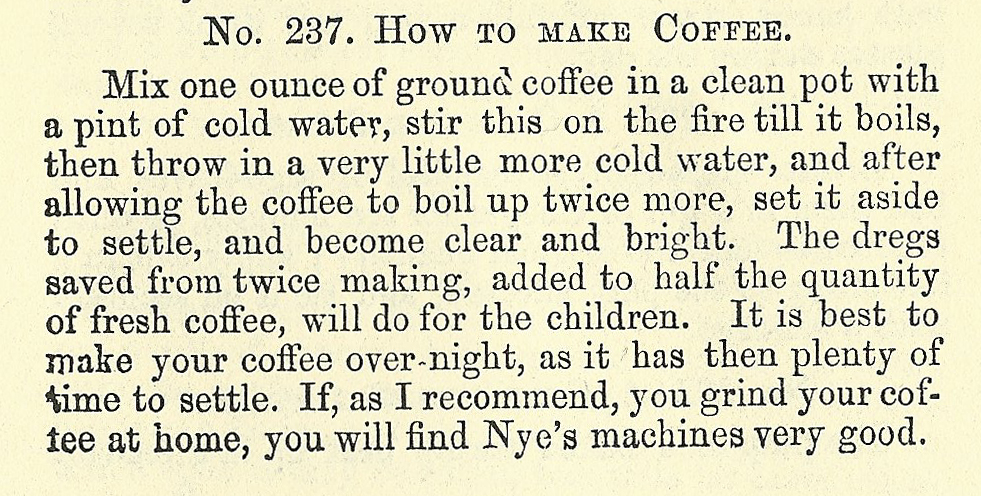
— But that’s awful. Coffee should be brewed the day before serving. How many times did you brew it?

— The once….

— Exactly! You didn’t boil it three times! No wonder it tastes like shit!

— Sir, there’s no need for profanity.

— This rubbish is what you’d serve a child, not a grown man. I want my money back.

— Very well. Here’s your tuppence ha’penny. Good luck, to you Sir.

A Plain Cookery Book for the Working Classes, Charles Elmé Francatelli, The Scolar Press, 1852


Tuesday, October 18, 2011

A Cure For Cancer


Good News! The cure for cancer has been found!

Seeing as a cure was published over 250 years ago, it begs the question: why has the medical establishment been pretending all this time to be working on that very same goal? Answer: the Crustacean Lobby.

Do you really think crabs would just sit back and let themselves be hunted into extinction for the sake of curing cancer? No! Believe me, as soon as word got out about these recipes featuring powdered crab’s claws, and crab eyes they mobilized by organizing Races Against the Cure from one end of the beach to the other.

It was fortunate for them they already had a public relations claw, though to be fair, its campaign against a common name for pubic lice has not gained much ground, and a great deal of energy has been expended in the splintering off of the Lobster contingent, who wanted to devote essential funds towards picketing a famous national restaurant chain.


 A spokes-crab had this to say: “We blame the Babylonians. If they hadn’t named a perfectly innocuous group of stars after us in their damnable zodiac, we would never have been targeted as a cure for cancer. While we sympathize with humans who suffer from this awful disease, we really wish you’d find some other way to rid yourselves of it.”

“Off the record,” he added in hushed tones, “Lobsters would make a pretty good substitute.”

The Compleat Housewife, Eliza Smith, 1742


Monday, October 17, 2011

Protein Health Salad


And the first place prize for “Biggest Tossed Salad” goes to this lovely lady.

“I’m just so thrilled to win!” she exclaimed. “I’ve been trying for years but always fell short. This time I adjusted my recipe and it worked!”

When asked what the secret to her success was, she told us “Well, I just kept adding lettuce. Whereas before, I’d always thought in terms of what I’d feed my family, this time around I went whole-hog and used three whole heads!”

As to her scrumptious-looking extras, she admits they weren’t planned. “I sort of ran out of time, to be honest,” she said. “So I ended up just throwing the mushrooms in whole."The name of her creation is Protein Health Salad. "It sounded catchy and appetizing to me," she noted.

“My husband calls me the world’s biggest tosser as it is, so it’s nice to finally live up to the name!”

When asked what she plans to do with her prize money, she tells us she wants to invest in more dried flowers and the occasional jelly mould. Well done!

Favorite Recipes for Salads, Lane Publishing Co., 1979

Sunday, October 16, 2011

It’s The Real Thing (What Is, Exactly?)


The text above reads:

If sugar is so fattening, how come so many kids are thin?

You’ve probably had people tell you they’re avoiding this or that because it has sugar in it.
         If you want to see how much sense there is to that idea, next time you pass a bunch of kids, take a look. Kids eat and drink more things made with sugar than anybody. But how many fat ones do you see?
       The fact is there’s no such thing as a fattening food, any more than there’s one that can make you thin.
       If you constantly take in more food than your body needs, you’ll probably get fat. If you eat a balanced diet in moderation, you probably won’t.
       When your daughter gets in from a couple of hours of practicing her baton twirling, or your husband’s sagging from finally painting the upstairs bedroom, they’re close to empty on readily available body fuel.
       That’s when eating or drinking something with sugar in it can give you a new supply of body fuel. In not too many minutes, they’ll be ready to go again.
       Sugar has a useful psychological effect, too. The good natural sweetness is like a little reward that promotes a sense of satisfaction and well-being.
       Good nutrition comes form a balanced diet. One that provides the right amounts, and right kinds of protein, vitamins, minerals, fats, and carbohydrates. Sugar is an important carbohydrate. In moderation, sugar has a place in a balanced diet.

Sugar isn’t just good flavor; it’s good food.

*     *     *     *     *

If this sounds familiar, chances are you have seen the Corn Refiner’s Association’s adverts concerning sugar’s replacement: High Fructose Corn Syrup (HFCS), which the corn industry is (unsuccessfully) trying to get the FDA to re-name “corn sugar.” The term “corn sugar,” however, is already in use — as dextrose. The HFCS ads are notorious examples of “badvertising” in that their combined visual, auditory and textual composition are misleading (mostly by omission).

Here’s one ad, and a transcript of it: 

If you’re like me, you care about the food your family eats. I was pretty confused by everything I’d been hearing about High Fructose Corn Syrup. So, I did a little research to find out what independent experts like doctors, dieticians and nutritionists had to say. I learned — whether it’s corn sugar or cane sugar, your body can’t tell the difference. Sugar is sugar. And that’s one less thing to worry about.

The key lines here are “whether it’s corn sugar or cane sugar, your body can’t tell the difference. Sugar is sugar.” This is patently untrue. It’s not a matter of interpretation; it’s a matter of basic science. What they are playing on is the complicated fact that “sugar” is a catch-all name that actually comprises several different chemical compounds, all of which sweeten in different ways. Fructose and Glucose (the main components of “sugar” and HFCS, but in different percentages) are metabolized, used and stored by the body differently. It’s iffy if your tongue can tell the difference (the popularity of Mexican Coke seems to suggest it can); your pocketbook can certainly tell the difference (the production of HFCS has been subsidized by the US government to the tune of $40 billion since the mid-1990s, and because it is a liquid, it is far easier to transport, thereby passing savings on to you);  and your body can indeed tell the difference (just ask your liver); it’s you whom they hope will remain in the dark.

Here’s another ad by the same folks:

Girl: (Offering ice-pop) You want a bite?
Guy: (Piqued) I thought you loved me.
Girl: (Puzzled) I do: take two bites.
Guy: (Disgusted) It’s got High Fructose Corn Syrup in it.
Girl: (Quizzical) So?
Guy: (Confidentially) Well, you know what they say about it.
Girl: (Shrugs) What?
Guy: (Mystified) That…it’s…um…
Girl: (Smiling) That it’s made from corn? Has the same calories as sugar, Honey, and is fine in moderation?
Guy: (Reassured) You only brought one?
Girl: (Laughs)

It is no accident that she calls him “Honey,” as the corn industry tries hard to align other “natural” sweet substances — maple syrup and honey being the two big ones — with corn syrup as all belonging to one big “natural” ambrosial bounty (cane and beet sugars — sucrose — are the other). While maple syrup and honey are naturally occurring substances which happen to be sweet, corn syrup is not — until it is refined by increasing the ratio of fructose to glucose. Sucrose is a disaccharide, while fructose and glucose are monosaccharides. While sucrose is processed by the pancreas (which produces insulin to balance it), fructose is processed by the liver, which tends to want to store it as fat.

So why not just use honey? Because not all honey is created equal. That’s because two thirds of it contains the same stuff as Equal, the artificial sweetener you see in the white and blue packets on your restaurant table. Commercial honeybees are fed HFCS, which makes its way into the honey. Only honey labeled “raw,” “100% Natural,” or “Organic” is actually pure honey. It’s also worth noting that genuine maple syrup is the only stuff actually made from maple trees. The cheaper kind sold for your pancakes is made almost entirely out of HFCS and flavorings.

While the HFCS industry has received a bad rap in recent years, it is not without cause; since it was introduced into the American diet, obesity rates have skyrocketed. Clearly, obesity has always been a public relations nightmare for sugar producers, as the ad above will testify. And just like their foes the corn industry, they seek to allay the public’s fears by calling for common sense and moderation.

The sugar ad from 1971 features a woman brandishing a cola that is not sweetened with HFCS, as it is today (HFCS was introduced into soft drinks in the US in 1984; a popular and persistent urban myth is that the introduction of “New Coke” in 1985 was engineered to mask the change in flavor). This is not so everywhere; if you like the “Real Thing,” you can buy Mexican Coke, which is still made with actual sugar.

One of the most obviously dated aspects of the sugar ad isn’t the claim that “there’s no such thing as a fattening food” or even that they draw attention to the addictive properties of sucrose due to it’s effect on the brain’s pleasure centers. It’s that they take for granted that kids could not possibly be fat. Indeed, the whole ad hangs on this premise, which sadly would not hold today. They had a point though: kids wouldn’t suffer nearly as many medical problems on sugar-based cola as they do on HFCS-based cola. This generation may have dodged a bullet while they were young, but sure caught it once they grew up.

Also; boys and girls use far less of their limbs to engage in extra-curricular activities today; while in 1971 they might have spent hours twirling batons and playing baseball, now they just use their thumbs to text and play games. Actually, most of us are all just twiddling our thumbs.


Saturday, October 15, 2011

Poxy Lady


Nineteenth century cookbooks didn’t just provide a literate wife or housekeeper with recipes for food — they also covered advice for everything you’d need to run a home. This approach didn’t really let up until the 1950s, when women jettisoned themselves from their kitchens into the workforce and fed their family with TV dinners. Such homemaker mavens as Martha Stewart revived the cult of the well-kept hearth with her many books, but steered clear of suggesting remedies for serious illnesses better left to medical professionals.

Not so her sisters of yesteryear: before doctors were as close as your nearest ER, a woman had to be her own triage unit, and her medicine kit consisted of items already on her shelves or in her garden. No seemingly fatal illness was deemed beyond her expertise, no matter how alarmingly contagious.

Small pox (so named to differentiate it from the “great pox,” or syphilis), one of the 18th century’s leading causes of death in Europe,  was eradicated in 1979. Smallpox enters the system via the mouth and first exhibits symptoms similar to a cold, hence this recipe for preventing a sore throat. A recipe for lessening the scars would have proven popular, as the pustules left behind a distinctive de-pigmented pit when they dried up and fell off.


Queen Elizabeth I wore heavy make-up to hide her smallpox scars; Stalin had his erased with photo re-touching. Smallpox was among the viruses chiefly responsible for wiping out great swaths of aboriginal peoples everywhere Europeans found them. 

Happily these are recipes we need never revisit. 

The Compleat Housewife, Eliza Smith, 1742


Friday, October 14, 2011

Crown Roast of Frankfurters


Some people just have no respect for the ancient institution of the monarchy. In the mid 1600s for example, an English bloke named Oliver Cromwell decided enough was enough, and took up arms against the royalists who, under Charles I had begun to wear enormous wigs and lacy doubloons and attended the theater all the time. He was so angry about this that he had Charles’s head lopped off. His son (the future Charles II — you can see where this is going…) high-tailed it to France to escape all the beheadings and such. (Good move.)

Cromwell was a rather persistent chap and melted down all of the crown jewels for good measure. As Lord Protector of the Commonwealth of England, he also conquered Scotland and Ireland, just in case, and systematically slaughtered all the Catholics he found there. The Welsh were too fierce and unintelligible to risk going to war against. Power to the People! 

Eventually God must have decided he liked the monarchy better, so he had them return to power shortly after Cromwell’s death. Still, this was not enough to satisfy a public too long deprived from the wigs and theater and such, so they had him executed posthumously, you know, just in case. Two and a half years after he was buried in Westminster Abbey, Cromwell’s dead body was disinterred, hung from chains and his head also lopped off. Oh the irony. As a deterrent to anyone else with a fancy to overthrow the prevailing government, his head was impaled on a spike and displayed outside Westminster Hall for 24 years. After a while it probably resembled a coconut and wasn’t as much fun for tourists to have their photograph taken with. His coconut was bought and sold over the intervening years until it was eventually buried again in 1960 (a full decade after the book this recipe comes from was published).

Cromwell’s Puritan spirit is clearly at work in the genius who devised this crown roast of wieners, the very epitome of a humble Everyman’s version of the real thing made from the ribs of a tasty beast. Chances are no-one will mention the discrepancy while they endure the brief period of humorlessness waiting for the good old days of heathen debauchery to return to the dining table. And their heads. 

Good times, good times.

Cooking for Young Homemakers, Culinary Arts Institute, 1950

Also from this book: Fried Brains, Fried and Baked, Roast OpossumRudolph the Red Nosed Pot Roast

Thursday, October 13, 2011

You Say Carat; I Say Carrot (Let's Call The Whole Thing Off)


How About A 24-Carrot Necklace?

Don’t do it, dude. Girlfriend is going to be pissed as hell if you try to slip a root vegetable ring on her finger after you propose. Things are going to get nasty if you get down on one knee, pop the question, trick her into saying “Yes!” then pull out this rubbish. Trust me, she will be able to tell the difference between a ring made from a “trifaceted chunk of avocado seed, sanded and lacquered, on a circlet of sweet potato” and an actual diamond solitaire engagement ring. Made out of metal and precious stones. That comes in a velvet-lined ring box. Preferably pale blue in color. With “Tiffany & Co.” embossed on it.

 No matter how nice your fiancée is (or was), she will not accept your excuse about being broke-ass broke and having to “be creative.” She might even play along to humor you, but watch your back.

This can go two ways: either she'll tell everyone you ever knew or ever hope to meet (after she drops your cheap sorry ass like a hot potato) what a douche you are so that you become the laughing stock of your worst nightmares, or she will actually marry you and you’ll be stuck with a woman whose standards are so low she won’t get up off her lazy ass to take the trash out of the trailer. She will cease giving a toss about her appearance, put on 200lbs, and continue to wear dried vegetable “jewelry” in public, rendering it impossible for you to leave the house. Either way, you will end up a lonely, frustrated recluse with no hope of ever having sex again.

If you doubt this, just look at the model’s expression. That’s not a smile; that’s a grimace. If you look into her eyes you can see her taking mental note to fire her agent, like, yesterday.

Note how the text plays fast and loose with archeological processes that take millions of years to accomplish: “You cut the vegetables, then let them dry into fascinating semiprecious stones.” If it were that easy, the Petrified Forest National Park wouldn’t have to keep posting signs warning visitors not to steal the gravel. That used to be wood, y’all!

What is saddest of all is that in 1972, Women’s Day thought this was a good use of their readership’s time and energy. According to one of the many cigarette ads in its pages is the perfect back-handed response to this drivel: “You’ve come a long way, baby.”


Wednesday, October 12, 2011

Roast Bambi


Bambi, the charming Disney film of 1942 is both beautiful and violent. It depicts the destructive encroachment of humans upon a pastoral wonderland where animated forest creatures enact the grand cycle of life.

First, Bambi’s mother is killed by hunters. Over the winter, Bambi reaches sexual maturity and falls in love with a doe named Faline. When Faline is approached by a rival male who asserts himself upon her, Bambi has to get all up in his face and push him off a cliff to his death. The evil humans return to burn the forest down, forcing the young lovers to flee, but they are separated. Faline is pursued by a pack of ravenous dogs but Bambi comes to her rescue and breaks out his Kung Fu on them. Bambi is shot and falls into a ravine where he is found by his father who tells him not to be such a pansy and together they  seek refuge on an island to which, miraculously, Faline has also managed to escape. Bambi succeeds his father and becomes the leader of all the animals, and Faline gives birth to twins. Everyone lives happily ever after.

Stop me if any of this reminds you of the Star Wars storyline.

Bambi reigned supreme as a tearjerker assured to give young children nightmares until it was supplanted by ET. It is with this in mind that you may enjoy this recipe for baby deer. Yum.

Marion Harland’s Complete Cook Book, The Bobbs-Merrill Company, 1906


Also by Marion Harland: Stained, The Alternate Tale of Squirrel NutkinThe Wet Blanket of Discouragement


Tuesday, October 11, 2011

One is Such A Lonely Number


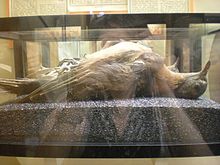
When a  Passenger Pigeon named Martha died at the ripe old age of 29 on September 1st, 1914 at her home (The Cincinnati Zoo), she was stuffed and put on display at the Smithsonian. Martha was the last of her kind in the whole world.

Martha, dead as a doornail
Her fate may have been sealed when she hatched in 1885. By that time, Passenger Pigeons were being hunted at a rate that made it impossible for them to survive. Passenger Pigeons were a species who could only breed in large communities, so not having many thousands of potential suitors on hand disinclined them from getting in the mood for love, no matter how much concerned ornithologists tried to relax them with a nice bit of dinner and candlelight. It is entirely possible then, that Martha died a virgin.

Martha, alive but lonely
Martha’s story is especially poignant because of the rapidity with which her species became extinct — it only took 20 years. Once numbering in the billions, they could not compete with hunters as more and more people moved West, and their communal nature doomed them further by making them so easy to kill en masse.

Recipe from Marion Harland's popular book
Practical and Exhaustive Manual of Cooking and Housekeeping of 1871
that contributed to the extinction of the Passenger Pigeon

Yes, I can hear you say, but what does all this have to do with that grotesque salad?

Imagine, if you will, that each layer in it represents all of the birds in North America. Look how robust their numbers are! There is no shortage of lettuce, peppers, mushrooms, onions, celery, peas, dressing, cheese and bacon. The lone stuffed olive sitting on top like Sleeping Beauty on her tower of mattresses is stuffed Martha, resplendently and magnificently alone.

Soup, Salad and Sandwich Cookbook, Ideals Publishing Corp., 1981

Also form this book: Frosted Sandwich Loaf, Potty Mouth, Penis Salad

Monday, October 10, 2011

Fear and Loathing in Safeways


Our trip was different. It was a classic affirmation of everything right and true and decent in the national character. It was a gross, physical salute to the fantastic possibilities of life in this country — but only for those with true grit. And we were choc full of that.

We were also choc full of flour and apples and eggs and mustard and onions and rice and ketchup and yogurt. We were piled high with honey and spaghetti and raw meats — ground beef and a disassembled chicken sealed in an unholy envelope of polystyrene and plastic wrap. There were lemons and lettuce and beans of all kinds and cans of tuna and great big vats of milk. There was something called “Cremette” my attorney threw in there at the very beginning for good measure. There was margarine and sauerkraut and cottage cheese and chow mein.

I had pleaded with him not to rip open a 10lb sack of flour right in the aisle because he was under the impression they were selling cocaine in the supermarkets now, a thought that delighted him so much he couldn’t wait to strip off this clothes and roll about in it, but the cashier glared at us and we thought we could see the handle of a gun poking out of her waistband so we struggled to haul it into the cart. Those damn things have wheels. Every time we thought we had it in the trolley it rolled away, so we ended up lumbering the entire length of the aisle until we managed to pin the cart against a stack of cans of cooking oil. We threw in two bags of “Whole Wheat” too just in case it was the real thing — you never know.

I was nervous about the cashier’s gun and suggested we just make a dash for it through the electronic doors into the parking lot but my attorney reminded me that this would constitute stealing, and the only things worth stealing were cars and guns, so we approached her with caution. The fluorescent lights were beginning to mess with my brain and I started sweating profusely. We had no money — how were we going to pay for all these groceries? It seemed inconceivable that women all over the country did this on a weekly basis. No wonder they were all stuffing valium down their gullets by the truckload.

“No sudden movements,” I said, “and stop swatting at those flying lizards. She’ll begin to get suspicious and call the cops.”

By the time we made it to the register we’d lost our appetite. The munchies had worn off and we were left with enough food to feed a small child of three for eleven years. There was nothing for it but to walk away. Very slowly at first.

Then we ran. 

 Budget Saving Meals Cookbook, Ideals Publishing Corp, 1980

Also from this book: Purple Haze, Nutty As A Fruitcake

Pin It